


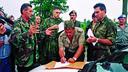
Ex-Yugoslav agent's testimony implicates Milošević, challenges Serbian narrative on Krajina
Translated from Croatian, summarized and contextualized by DistantNews.
At a glance
News
Named sources
Context piece
- Slobodan Lazarević, a KOS agent involved in negotiations for the surrender of the 21st Kordun Corps, provided testimony in The Hague that implicated Milošević.
- His testimony reveals truths about Krajina and suggests Belgrade intended to sacrifice thousands of Serb soldiers and civilians in Topusko, blaming Croatia.
- Lazarević's evidence challenges the narrative that Belgrade merely provided political backing for Krajina, showing instead that key decisions were made in Belgrade.
A former agent of the Yugoslav intelligence service KOS, Slobodan Lazarević, has provided testimony in The Hague that significantly challenges Serbian narratives surrounding the Krajina conflict. Lazarević, who participated in negotiations for the surrender of the 21st Kordun Corps, directly implicated Slobodan Milošević and revealed Belgrade's alleged plans to sacrifice thousands of Serb soldiers and civilians in Topusko.
According to the report, Lazarević's testimony exposes a plan by Belgrade to "turn Topusko into Srebrenica and blame Croatia." This alleged scheme aimed to create a massacre scenario and frame Croatia for the atrocities, thereby undermining international support for Zagreb. The agent's account suggests a deliberate strategy to manipulate events and international opinion.
Crucially, Lazarević's evidence dismantles the long-held assertion that Belgrade was merely a passive political supporter of the self-proclaimed Republic of Serbian Krajina. His testimony indicates that all pivotal decisions concerning the region were ultimately made in Belgrade, directly contradicting claims of regional autonomy and underscoring Serbian central control.
This revelation offers a new perspective on the Krajina conflict, suggesting a more active and manipulative role for the Milošević regime. The agent's willingness to testify against his former superiors and expose these alleged plans marks a significant development in understanding the complexities of the Balkan wars.
DistantNews Editorial
Originally published by Večernji List in Croatian. Translated, summarized, and contextualized by our editorial team with added local perspective. Read our editorial standards.
More Stories



From Our Blog

What Gets Lost (and Found) When News Is Translated

The Critical Role of Diaspora Media in Global News

What Travellers Should Know About Countries with Restricted Press

A Digital Nomad's Guide to Following Local News

How the Same Story Looks Different in Different Countries
