


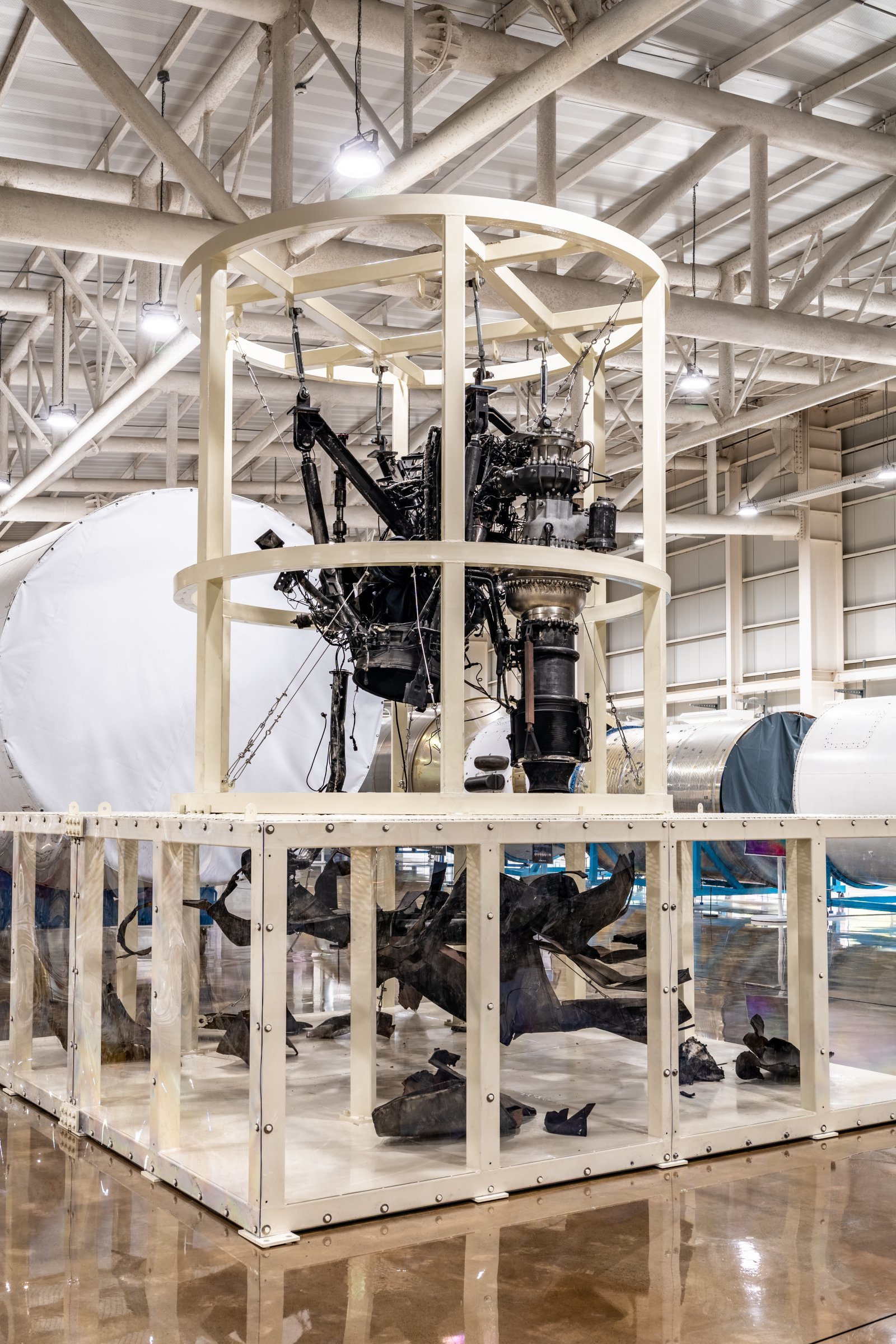
Exploded Nuri rocket engine goes on display, showcasing development challenges
Translated from Korean, summarized and contextualized by DistantNews.
At a glance
News
Official statement
Context piece
- A Nuri rocket engine that exploded during testing is now on public display at the Naro Space Center.
- This is the first time a damaged engine from a test explosion has been exhibited in its damaged state.
- The exhibition aims to show the process of rocket development, which involves numerous tests, failures, and improvements.
A 75-ton class engine for South Korea's Nuri rocket, which exploded during a development test, is now on public display at the Naro Space Center's Space Science Hall. This marks the first time an engine damaged during a test explosion has been exhibited in its original, fractured condition.
Visitors can witness firsthand the engine's damage caused by the explosion, offering a tangible understanding of the rigorous process behind space rocket development. This process is characterized by continuous testing, analysis, and refinement, often involving numerous failures before success.
The Korean Aerospace Research Institute (KARI) produced a total of 17 engines of the 75-ton class for Nuri's development, including 14 for the first stage and three for the second stage. These engines underwent 152 combustion tests, totaling 15,091 seconds. The engine now on display, designated 17A, was a second-stage engine that exploded shortly after ignition during its eighth combustion test on May 13, 2020, while undergoing certification testing.
Following the incident, KARI meticulously collected all engine debris to determine the cause of the explosion. The findings were then incorporated into improvements in engine design and testing procedures, contributing to the subsequent successful launches of the Nuri rocket. KARI views the damaged engine as a valuable record of South Korea's space rocket development journey and an educational tool for future generations.
While the engine's damaged form is preserved for display, the turbopump component has been removed for further research and replaced with a model to maintain the engine's overall shape. Certain parts requiring technical security are covered. KARI President Lee Sang-chul stated that the Space Science Hall serves as a space to experience the history of South Korea's space rocket development, particularly highlighting the self-reliant development achieved through overcoming failures and adversities.
The Space Science Hall is a space where one can fully feel the history of South Korea's space rocket development, and it is a place where one can experience firsthand through physical exhibits the process of achieving independent development of space rockets by overcoming failures and adversities.
DistantNews Editorial
Originally published by Dong-A Ilbo in Korean. Translated, summarized, and contextualized by our editorial team with added local perspective. Read our editorial standards.
More Stories


From Our Blog

What Gets Lost (and Found) When News Is Translated

The Critical Role of Diaspora Media in Global News

What Travellers Should Know About Countries with Restricted Press

A Digital Nomad's Guide to Following Local News

How the Same Story Looks Different in Different Countries
