


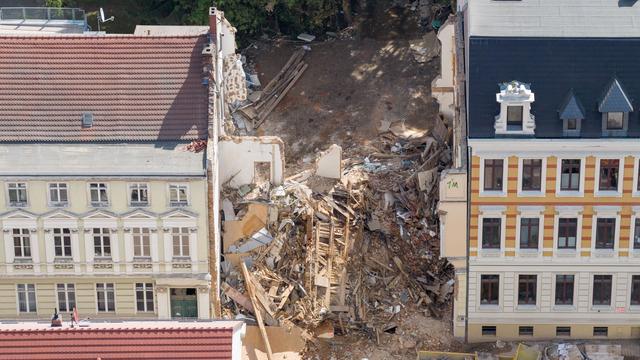
Explosion in Görlitz: Prosecutor's office explains communication on house collapse
Translated from German, summarized and contextualized by DistantNews.
At a glance
News
Official statement
In the courts
- The Görlitz public prosecutor's office defended its communication practices regarding a house collapse that killed three people.
- Critics had questioned why details about suspects were not released earlier.
- The office stated that releasing information requires balancing suspect privacy with public interest and sufficient evidence.
The Görlitz public prosecutor's office has defended its communication strategy concerning a house collapse that resulted in three fatalities, pushing back against criticism over the timing of suspect information release. The authority stated that its press work consistently balances the privacy rights of suspects with the public's right to information. It emphasized that releasing details about ongoing investigations, including naming suspects, is only justifiable when the evidence surpasses a mere initial suspicion.
"In this respect, an earlier publication of details of the investigations to date and the naming of two suspects could not be justified. First, evidence had to be created that went beyond a vague initial suspicion," the office explained in response to an inquiry. The incident on May 18 claimed the lives of two young Romanian women and a German-Bulgarian national. The two suspects, aged 27 and 33, are from Poland and Afghanistan and are accused of damaging or tampering with gas lines in the building, leading to the explosion.
One suspect has been in custody since May 21, and the other since May 29. The prosecutor's office pointed to a joint press release with the police on June 8, which provided some investigative details and first reported on the suspects the previous evening. Initial leads against the two men reportedly came from Polish police on May 20.
The office's defense highlights the legal complexities involved in communicating sensitive information during criminal investigations, particularly when lives have been lost. The priority remains on building a solid case while managing public expectations and transparency.
In this respect, an earlier publication of details of the investigations to date and the naming of two suspects could not be justified. First, evidence had to be created that went beyond a vague initial suspicion.
DistantNews Editorial
Originally published by Die Zeit in German. Translated, summarized, and contextualized by our editorial team with added local perspective. Read our editorial standards.
More Stories

From Our Blog

What Gets Lost (and Found) When News Is Translated

How the Same Story Looks Different in Different Countries

The Critical Role of Diaspora Media in Global News

What Travellers Should Know About Countries with Restricted Press

A Digital Nomad's Guide to Following Local News
