


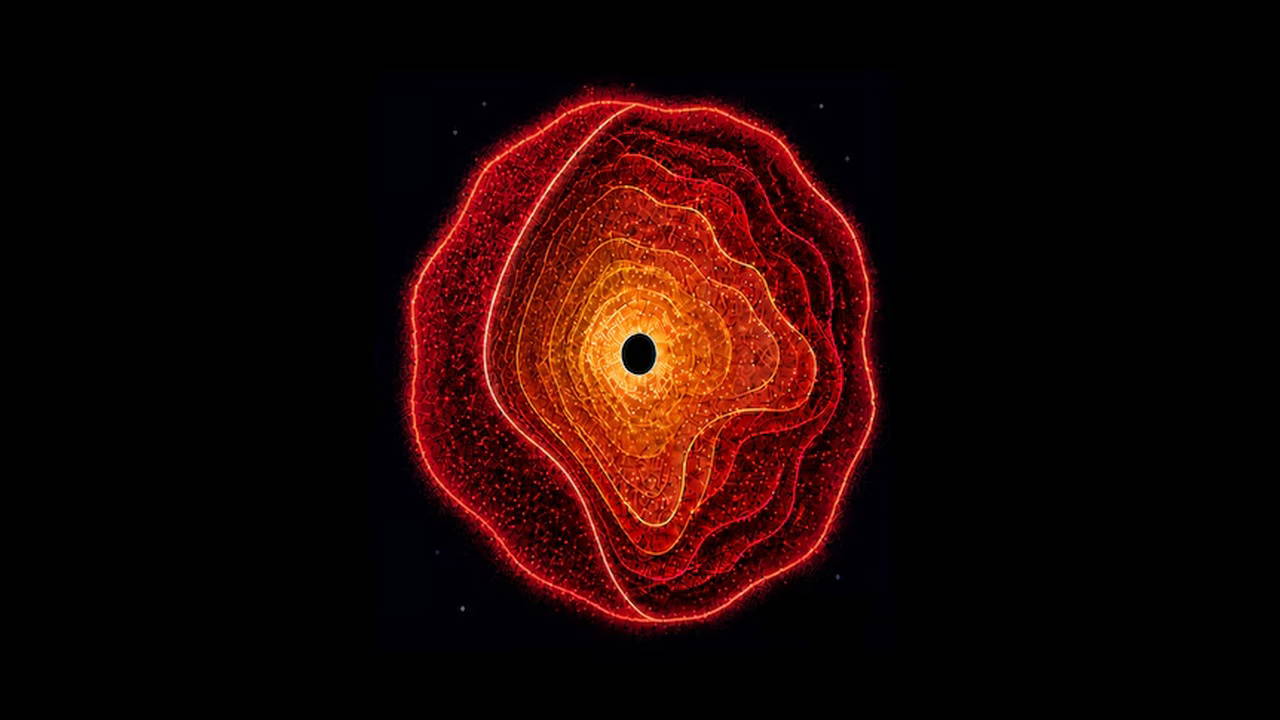
Extraordinary Discovery in Space: Object Emits 100 Billion Times More Energy Than Known Stars
Translated from Turkish, summarized and contextualized by DistantNews.
At a glance
News
Sources not specified
Context piece
- An international research team identified a bright red object, dubbed 'MoM-BH*-1', in images from NASA's James Webb Space Telescope.
- Simulations suggest the object is not a star but a black hole, roughly the size of our solar system, surrounded by a dense gas layer that makes it appear to emit light.
- This
Astronomers have discovered a celestial object that defies current understanding, potentially representing a new class of cosmic entity. Dubbed 'MoM-BH*-1', the object was identified in images captured by NASA's James Webb Space Telescope.
An international research team's detailed analysis, aided by computer simulations, has led them to conclude that MoM-BH*-1 is not a star. Instead, they propose it is a black hole, estimated to be the size of our solar system. The object is enveloped in a dense gas layer, which causes it to emit light, mimicking the appearance of a star. Scientists emphasize that despite its stellar appearance, the object radiates energy approximately 100 billion times greater than any known star could produce.
Researchers estimate that MoM-BH*-1 formed about 660 million years after the Big Bang and is located billions of light-years from Earth. Dr. Rohan Naidu of the Massachusetts Institute of Technology's Kavli Institute for Astrophysics and Space Research, the lead author of the study, described the discovery as a "black hole star." He noted that this object exhibits characteristics associated with stars while emitting energy at levels comparable to black holes.
The findings, published in the journal Nature, open new avenues for astrophysical research. The discovery challenges existing models of celestial bodies and suggests the possibility of phenomena that bridge the gap between black holes and stars.
DistantNews Editorial
Originally published by Cumhuriyet in Turkish. Translated, summarized, and contextualized by our editorial team with added local perspective. Read our editorial standards.
More Stories



From Our Blog

What Gets Lost (and Found) When News Is Translated

The Critical Role of Diaspora Media in Global News

What Travellers Should Know About Countries with Restricted Press

A Digital Nomad's Guide to Following Local News

How the Same Story Looks Different in Different Countries
