


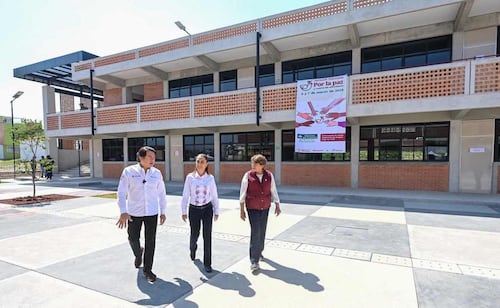
Federal and State of Mexico governments to build new high schools in eastern region
Translated from Spanish, summarized and contextualized by DistantNews.
At a glance
News
Sources not specified
New plan
- The federal and State of Mexico governments will build new "Margarita Maza" technological high schools in the eastern region.
- The initiative aims to provide educational opportunities for 13,860 young people and reduce educational backlog.
- The plan includes converting existing secondary schools and opening cyber high schools to expand coverage.
The federal government and the State of Mexico are set to construct new "Margarita Maza" technological high schools and convert existing ones in the eastern region of the state. This initiative aims to offer educational opportunities to 13,860 young people, allowing them to study closer to home and addressing educational disparities.
This expansion of educational offerings is part of the "Plan Oriente" for the State of Mexico, a strategy jointly promoted by presidential hopeful Claudia Sheinbaum Pardo and Governor Delfina Gómez Álvarez. The plan specifically targets one of the country's fastest-growing regions, seeking to reduce educational backlog.
The project encompasses nine technological high schools, six of which are already operational in municipalities such as Chalco, Chimalhuacán, Ecatepec, Ixtapaluca, Nezahualcóyotl, and Texcoco. Additionally, three new campuses will be constructed this year in Chicoloapan, La Paz, and Valle de Chalco. The plan also involves converting six evening secondary schools to offer high school programs, located in Chalco, Chimalhuacán, Ixtapaluca, Ecatepec, Valle de Chalco, and Chicoloapan.
The "Margarita Maza" high schools will provide technological training with curricula aligned to current labor market needs. These include specializations in Artificial Intelligence, Cybersecurity, Nanotechnology, Business Intelligence, Digital Production, Logistics, General Nursing, Urbanism and Sustainable Development, and Agricultural Production Systems. The goal is to enhance students' prospects for further education or entry into the workforce.
Beyond education, the comprehensive plan includes infrastructure development in mobility, health, potable water, drainage, housing, and urban services, aiming to improve the quality of life for over 10 million residents in the region.
DistantNews Editorial
Originally published by El Universal in Spanish. Translated, summarized, and contextualized by our editorial team with added local perspective. Read our editorial standards.
More Stories


From Our Blog

What Press Freedom Means for the News You Read

What Gets Lost (and Found) When News Is Translated

The Critical Role of Diaspora Media in Global News

What Travellers Should Know About Countries with Restricted Press

A Digital Nomad's Guide to Following Local News
