


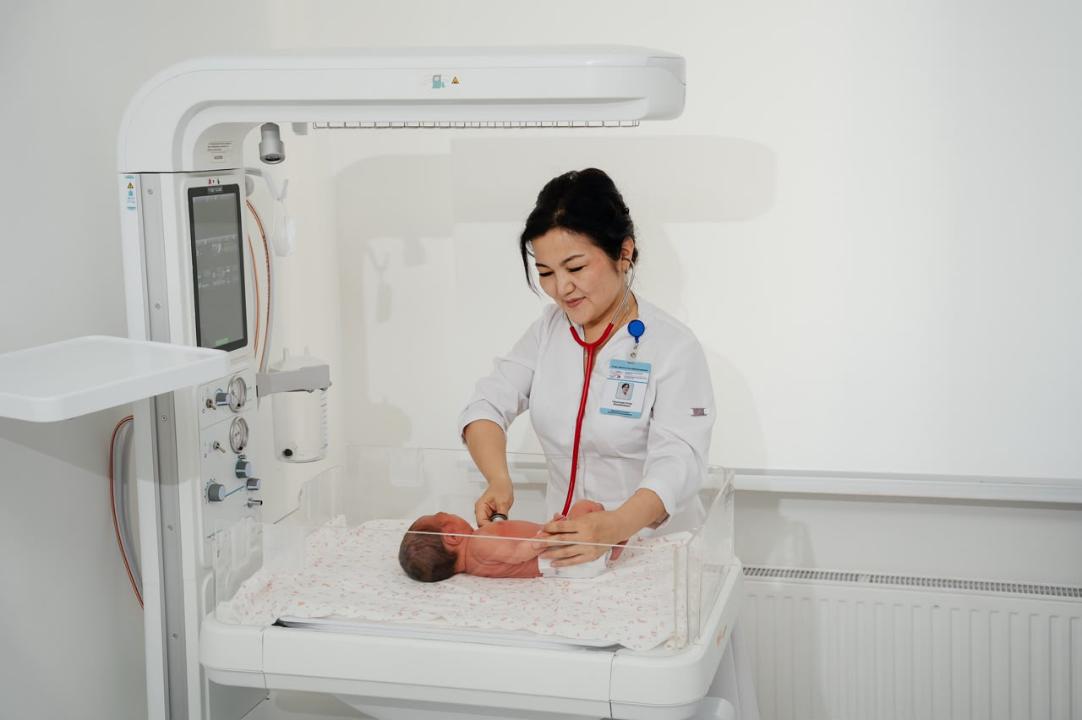
Fewer Births, Better Chances: Kazakhstan Advances in Newborn Care
Summarized and contextualized by DistantNews.
At a glance
News
Documents & data
Context piece
- Kazakhstan recorded nearly 150,000 births in the first half of 2026, a 7% year-on-year decrease, while neonatal mortality fell to 3.9 per 1,000 live births in 2025, the lowest in Central Asia.
- The declining birth rate aligns with a global trend, with Kazakhstan's total fertility rate dropping to 2.57 children per woman in 2025.
- Despite fewer births, specialized neonatal care has improved significantly, with mortality for newborns with severe congenital conditions falling more than threefold in five years, and postoperative survival rising to 93%.
Kazakhstan is experiencing a notable decline in births, with nearly 150,000 recorded in the first half of 2026, a 7% decrease from the previous year. This trend mirrors a broader global demographic shift, as evidenced by Kazakhstan's total fertility rate falling from 3.32 children per woman in 2021 to 2.57 in 2025.
Concurrently, the nation is celebrating significant advancements in newborn care. Neonatal mortality has reached a record low of 3.9 per 1,000 live births in 2025, positioning Kazakhstan as having the lowest rate in Central Asia. This improvement is particularly evident in the care of premature infants and those born with severe congenital conditions.
Over the past five years, mortality rates for newborns with severe congenital conditions have plummeted by more than threefold, from 22% to 6.9%. Postoperative survival rates have surged to an impressive 93%. These successes are attributed to the development of obstetric and neonatal services, the integration of modern medical technologies, and the dedicated efforts of specialized medical teams.
Advances in prenatal diagnostics, detecting conditions as early as 18-20 weeks of pregnancy, are expanding treatment options. Expectant mothers with identified fetal abnormalities are referred to specialized perinatal centers, enabling timely interventions and preparation for immediate postnatal care. Neonatal and pediatric surgeon Zhenis Sakuov emphasized that successful treatment hinges on seamless coordination among the entire medical team, highlighting the complexity of operating on newborns, especially premature ones, and the critical need for specialized post-operative care. Last year, approximately 17,000 premature babies received such specialized care in Kazakhstan.
Operating on newborns is difficult, and operating on premature babies is even more difficult because they require specialized preparation for surgery. The operation itself is complex, the postoperative period is complex, and they need specialized care afterward. This is teamwork.
DistantNews Editorial
Originally published by The Astana Times. Summarized and contextualized by our editorial team with added local perspective. Read our editorial standards.
More Stories


From Our Blog

What Gets Lost (and Found) When News Is Translated

The Critical Role of Diaspora Media in Global News

What Travellers Should Know About Countries with Restricted Press

A Digital Nomad's Guide to Following Local News

How the Same Story Looks Different in Different Countries
