


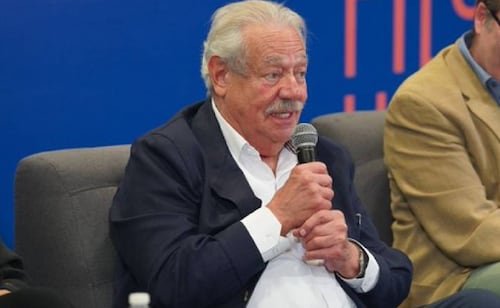
 Image: UNAM.
Filuni Honors 2025 Cervantes Prize Winner Gonzalo Celorio
Translated from Spanish and summarized by DistantNews. Read the original for the full story.
At a glance
In-depth
Named sources
Context piece
- Writers and academics honored Mexican author Gonzalo Celorio at Filuni after he received the 2025 Cervantes Prize.
- Speakers praised his prose, work with autofiction, engagement with memory and influence as a teacher and university cultural leader.
- Participants highlighted Celorio’s role at the UNAM Faculty of Philosophy and Letters and his view of literature as a way to understand cities, history and culture.
Gonzalo Celorio was celebrated at Mexico’s International Book Fair of Universities for a body of work that speakers said connects literary invention with memory, the city and university life.
Rosa Beltrán, coordinator of cultural outreach at the National Autonomous University of Mexico, described Celorio not only as a major teacher but also as a cultural administrator and president of the Mexican Academy of Language. “I was not his student in the classroom, but he has been my teacher in many ways,” she said.
I was not his student in the classroom, but he has been my teacher in many ways.
Writer Eloy Urroz called Celorio the author of the best prose currently being written in Spanish, then softened the claim to “one of the best.” Verónica Murguía focused on his novel “The Apostates,” saying it had dazzled her and broken her heart on first reading. She described it as a painful novel because Celorio had to use literature to enter the minds of his siblings.
One of the best, something that hardly anyone cares about today because they do not know that words matter.
Poet Eduardo Casar brought humor to the discussion, saying, “I have worked in several of Gonzalo Celorio’s novels as a character.” He also called Celorio the founder of autofiction in Mexican literature and described the form as a path toward sincerity.
Academic Mary Frances Teresa Rodríguez Van Gort called Celorio “deeply and dearly, a soul of our Faculty.” She said the Faculty of Philosophy and Letters shaped him, first as a student and teacher and later as an active director. His classes, she said, brought literature into dialogue with philosophy, art, architecture, the city, memory and language.
I have worked in several of Gonzalo Celorio’s novels as a character.
She added that teaching literature for Celorio meant more than transmitting information about authors or books. It meant teaching students to see a city through its historical layers, recognize in a novel a way of understanding the world and find centuries of memory, imagination and culture behind a word. The tribute honored not only a narrator, chronicler and essayist, but also a university figure who made literature a form of teaching.
Deeply and dearly, a soul of our Faculty.
About this summary
Originally published by El Universal in Spanish. Translated, summarized, and contextualized automatically by DistantNews, with a note on how the source frames the story. Not individually reviewed before publishing. How this works.
More Stories

From Our Blog

What Press Freedom Means for the News You Read

What Gets Lost (and Found) When News Is Translated

The Critical Role of Diaspora Media in Global News

What Travellers Should Know About Countries with Restricted Press

A Digital Nomad's Guide to Following Local News
