


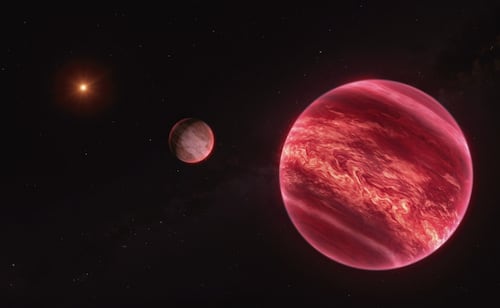
First natural satellite found outside the Solar System
Translated from Spanish, summarized and contextualized by DistantNews.
At a glance
News
Named sources
Context piece
- Scientists have discovered the first natural satellite outside our Solar System, an exosatellite orbiting a brown dwarf.
- The discovery was made using observations from the European Southern Observatory's extremely large telescope, led by Chilean researchers.
- This unprecedented finding opens new avenues for scientific inquiry into the formation and existence of such celestial bodies.
In a groundbreaking discovery, scientists have identified the first natural satellite beyond our Solar System, an exosatellite orbiting a brown dwarf. While over 6,000 exoplanets have been cataloged outside our solar system, this marks the first detection of an exosatellite.
The finding, detailed in the journal Nature, was led by Chilean researchers utilizing observations from the European Southern Observatory's extremely large telescope. The celestial body is described as a gas giant roughly the size of Jupiter, completing an orbit around its brown dwarf host star approximately every 170 days.
Astrophysicist Alice Zurdo, a professor at the University Diego Portales and director of the research project, highlighted the significance of the discovery. "This milestone opens new challenges and questions for the scientific community to answer, such as when this satellite formed, why it exists, or how many more there are," Zurdo stated in an interview.
Researchers are still determining if the object can be definitively classified as an "exoluna," with Zurdo noting that "there is nothing comparable in the Solar System." This unprecedented discovery promises to reshape our understanding of planetary and satellite formation beyond our own cosmic neighborhood.
DistantNews Editorial
Originally published by El Universal in Spanish. Translated, summarized, and contextualized by our editorial team with added local perspective. Read our editorial standards.
More Stories



From Our Blog

What Press Freedom Means for the News You Read

What Gets Lost (and Found) When News Is Translated

The Critical Role of Diaspora Media in Global News

What Travellers Should Know About Countries with Restricted Press

A Digital Nomad's Guide to Following Local News
