


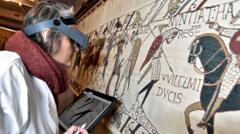
Five key scenes from the Bayeux Tapestry, and the story they tell
Summarized and contextualized by DistantNews.
At a glance
In-depth
Named sources
Context piece
- The Bayeux Tapestry, a nearly 1,000-year-old 70m-long embroidered cloth, depicts the Norman conquest of England and the 1066 Battle of Hastings.
- The tapestry, currently on display at the British Museum, tells the story of William the Conqueror's rise to power, focusing on key events like Harold's oath and the subsequent omens of doom.
- Dr. David Musgrove highlights five key scenes, explaining how the tapestry portrays Harold's transition from a heroic figure to a villain after allegedly breaking an oath to William.
The Bayeux Tapestry, an extraordinary 70-meter-long embroidered cloth dating back nearly a millennium, offers a vivid visual narrative of the Norman conquest of England and the pivotal Battle of Hastings in 1066. This ancient artifact, currently making a rare appearance at the British Museum after over 900 years, presents a medieval "game of thrones" as William the Conqueror vied for the English throne against King Harold.
He's being given arms and armaments by Duke William, and this is really important because the subtext of the first half of the tapestry is essentially to present Harold as a heroic figure.
Dr. David Musgrove, a co-author on the tapestry's history, guides us through five crucial scenes that unfold the epic story. The tapestry begins by portraying Harold, England's most powerful earl, in a positive light during his 1064 or 65 mission to Normandy. "He's being given arms and armaments by Duke William, and this is really important because the subtext of the first half of the tapestry is essentially to present Harold as a heroic figure," Dr. Musgrove explains.
He actually looks physically contorted and conflicted. At least that's my take on it. He looks as if he's kind of a bit anguished about having to make this oath.
A pivotal moment, considered the most significant by Dr. Musgrove, depicts Harold making an oath while touching holy relics, believed to be swearing allegiance to William as King Edward's successor. "He actually looks physically contorted and conflicted," Dr. Musgrove observes, suggesting Harold appears anguished. This scene marks Harold's dramatic shift from hero to "zero" in the tapestry's narrative.
This scene is basically where Harold goes from hero in the first part to zero in the second part.
Following King Edward the Confessor's death in January 1066, Harold claims the throne, a move depicted as a betrayal of his oath, turning him into the "villain of the piece." The appearance of Halley's Comet, visible only every 75 years, is shown as a dire omen following Harold's alleged betrayal, with onlookers pointing to the sky, signifying impending doom. The tapestry visually communicates that Harold's coronation would lead to a disastrous outcome, which indeed followed.
So he's gone against this supposed oath, and this is where he becomes the villain of the piece. This is a really important moment.
DistantNews Editorial
Originally published by BBC News. Summarized and contextualized by our editorial team with added local perspective. Read our editorial standards.
More Stories



From Our Blog

What Gets Lost (and Found) When News Is Translated

The Critical Role of Diaspora Media in Global News

What Travellers Should Know About Countries with Restricted Press

A Digital Nomad's Guide to Following Local News

How the Same Story Looks Different in Different Countries
