


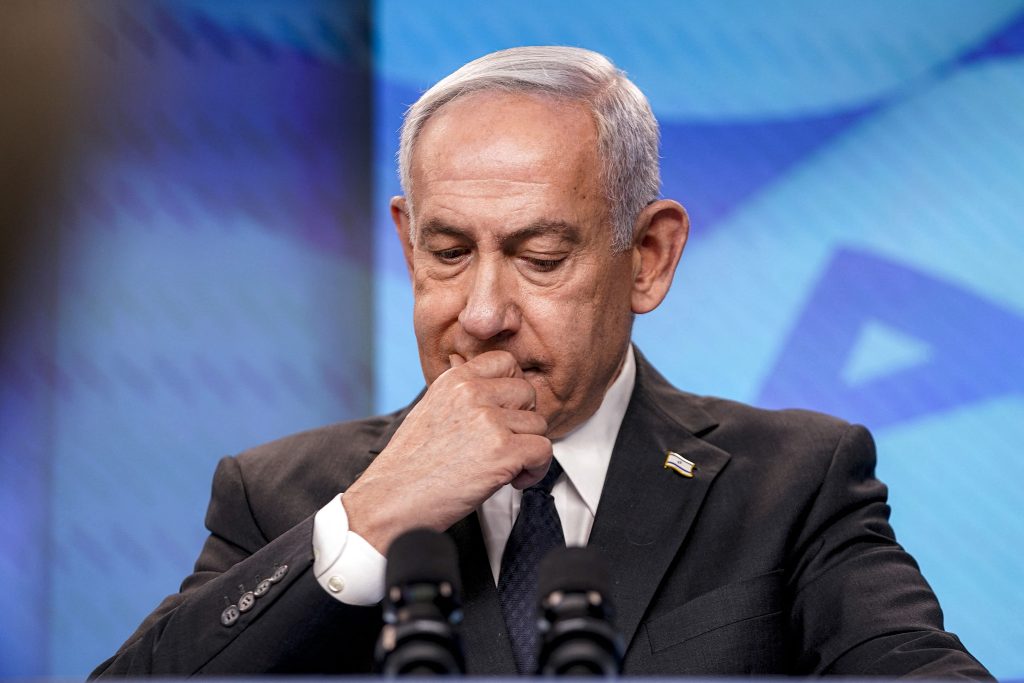
Following Iran Deal, Netanyahu Suffers Political Setback in Polls
Translated from French, summarized and contextualized by DistantNews.
At a glance
News
Sources not specified
Context piece
- An agreement between Washington and Tehran has led to a political shift in Israel's opposition, with Gadi Eisenkot gaining support while Netanyahu and Bennett lose ground.
- Polls show Eisenkot's party, Yashar, projected to win 21 seats, surpassing Netanyahu's Likud (23 seats) and Bennett's 'Ensemble' party (17 seats).
- A majority of Israelis (55%) oppose the US-Iran agreement, fearing Iran will remain a threat despite the deal.
The recent announcement of a memorandum of understanding between Washington and Tehran has triggered a significant realignment within Israel's political opposition, bolstering Gadi Eisenkot's Yashar party while diminishing the standing of Prime Minister Benjamin Netanyahu and former premier Naftali Bennett. This shift is vividly reflected in recent opinion polls, suggesting a dynamic political landscape just months before crucial elections.
The announcement of a memorandum of understanding between Washington and Tehran provokes a redistribution of forces within the Israeli opposition: Gadi Eisenkot gains power, while Netanyahu and Bennett lose ground.
Gadi Eisenkot, leader of the Yashar party, has seen a notable surge in poll numbers following the US-Iran deal announcement. Current surveys credit Yashar with 21 seats. In contrast, Netanyahu's Likud party and Bennett's 'Ensemble' party have seen their projections drop to 23 and 17 seats, respectively. This redistribution of projected seats indicates a growing public focus on the Iran deal and the perceived threat from Iran.
The poll currently credits the Yashar party with 21 seats, while Netanyahu's Likud and Bennett's 'Ensemble' party fall back to 23 and 17 seats respectively.
Further reinforcing this trend, a poll published by KAN 11 shows Eisenkot's Yashar party becoming the leading opposition force, overtaking the joint list of Bennett and Yair Lapid. The public sentiment appears largely unfavorable towards the agreement, with 55% of respondents opposing the US-Iran deal, compared to only 18% in favor. A significant 70% of participants expressed concern that Iran will continue to pose a threat, even with the new agreement in place.
55% of respondents declare their opposition to the agreement between the United States and Iran, compared to only 18% who approve it, while 27% state they have no firm opinion.
This widespread skepticism highlights a deep-seated distrust within Israeli society regarding any normalization with Tehran, which is widely viewed as premature and insufficiently guaranteed. The results contrast sharply with a Maariv newspaper poll from just two weeks prior, which had given Bennett's 'Ensemble' party 22 seats. This erosion has prompted media commentators to question Bennett's political future and the potential for him to align with Eisenkot, or even join his camp. A poll by Direct Polls for i24NEWS found that 66% of opposition voters believe Bennett should now support Eisenkot in anticipation of a future electoral confrontation with Netanyahu.
70% of participants indicate they fear that Iran will continue to represent a threat, despite the new agreement being finalized.
DistantNews Editorial
Originally published by El Watan in French. Translated, summarized, and contextualized by our editorial team with added local perspective. Read our editorial standards.
More Stories


From Our Blog

What Gets Lost (and Found) When News Is Translated

The Critical Role of Diaspora Media in Global News

What Travellers Should Know About Countries with Restricted Press

A Digital Nomad's Guide to Following Local News

How the Same Story Looks Different in Different Countries
