

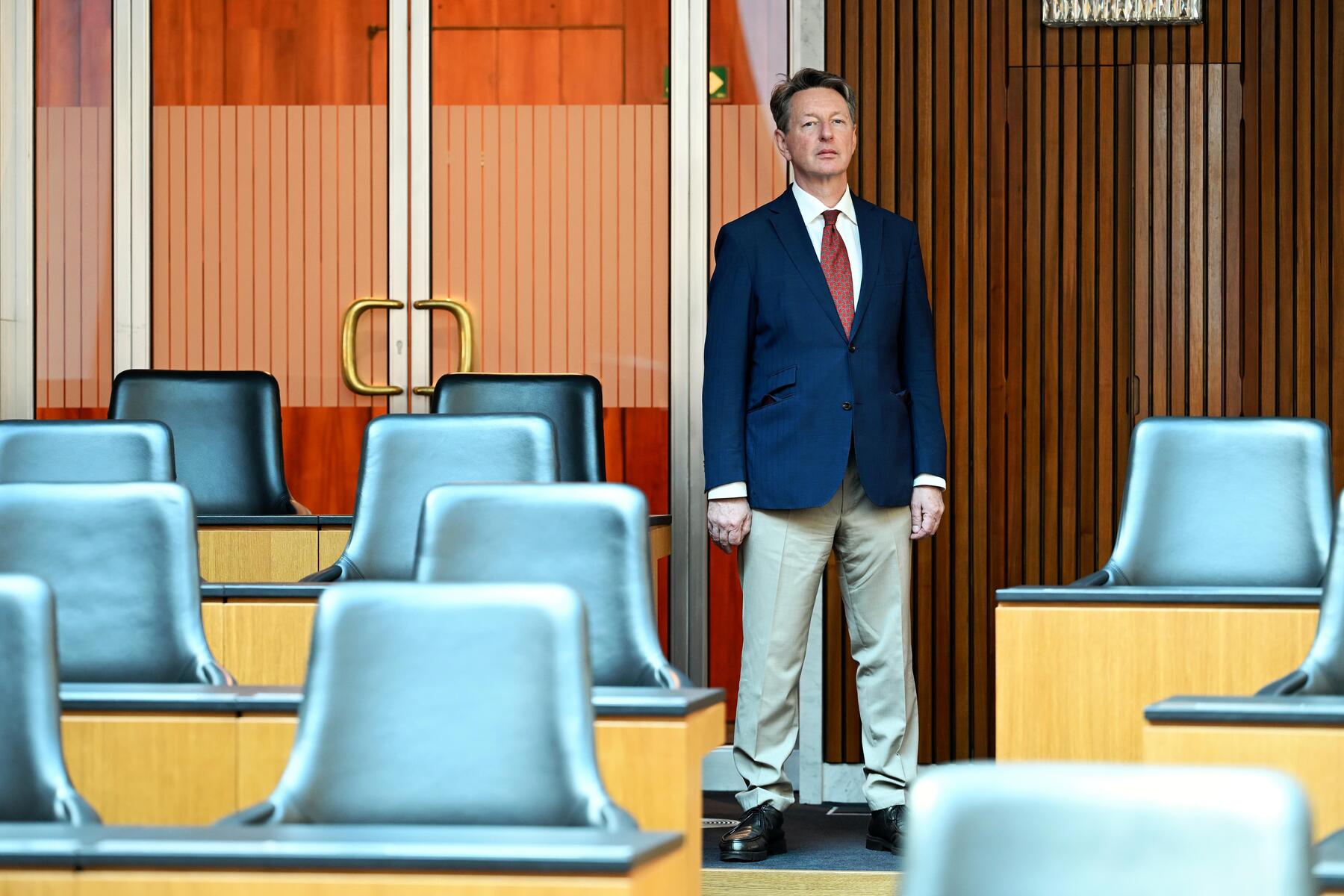
FPÖ ideologue plans party's 'counter-revolution'
Translated from German, summarized and contextualized by DistantNews.
At a glance
In-depth
Sources not specified
Context piece
- Norbert Nemeth, a key ideologue for Austria's Freedom Party (FPÖ), is shaping the party's upcoming election program around the concept of freedom.
- Nemeth defines freedom through four pillars: state sovereignty, individual liberty, solidarity, and homogeneity, emphasizing shared characteristics among people forming a state.
- A confidant of FPÖ leader Herbert Kickl, Nemeth has a history of influencing coalition negotiations and is profiled in a new series on party ideologues.
Norbert Nemeth, a central ideologue for Austria's Freedom Party (FPÖ), is spearheading the development of the party's election program for 2024, focusing on the core concept of "freedom." Nemeth, who also played a significant role in coalition talks in 2017 and 2025, is structuring the program around four distinct pillars: state sovereignty, individual liberty, solidarity, and homogeneity. He articulates homogeneity as the belief that people with similar characteristics form a cohesive state, a notion echoed by FPÖ leader Herbert Kickl, who described it as the "soul" of a nation.
From the conviction that people who are similar to each other form a state – and not those who are dissimilar.
Nemeth's influence within the FPÖ is substantial. As the director of the FPÖ parliamentary club and a close associate of Kickl, he guides the party's operational strategy. Beyond daily political affairs, Nemeth actively engages in fundamental debates as the president of the Attersee Circle, an FPÖ think tank. His background is not rooted in a traditional FPÖ family; he became a supporter in the mid-1980s, inspired by Jörg Haider's charisma. His early political involvement included membership in student fraternities and later, he met Heinz-Christian Strache, who would become the FPÖ chairman.
Homogeneity is the soul of a state.
After studying law, Nemeth moved to Upper Austria and began his career in the office of an FPÖ state councilor in Lower Austria. He later followed this mentor to the People's Advocate's office, serving as a specialist referent. A pivotal moment in his career was the FPÖ's split and the subsequent formation of the BZÖ in 2005. Nemeth recounts that the FPÖ was marginalized at the time, lacking a parliamentary club and reduced to just two representatives. The party's fortunes improved after the 2006 election, under Strache's leadership, securing eleven percent of the vote. Nemeth then accepted Strache's offer to rebuild the FPÖ's parliamentary club, a role he has held since 2006.
The FPÖ was sidelined in parliament at the time. We no longer had a club and only two representatives.
DistantNews Editorial
Originally published by Die Presse in German. Translated, summarized, and contextualized by our editorial team with added local perspective. Read our editorial standards.
More Stories


From Our Blog

What Gets Lost (and Found) When News Is Translated

The Critical Role of Diaspora Media in Global News

What Travellers Should Know About Countries with Restricted Press

A Digital Nomad's Guide to Following Local News

How the Same Story Looks Different in Different Countries
