

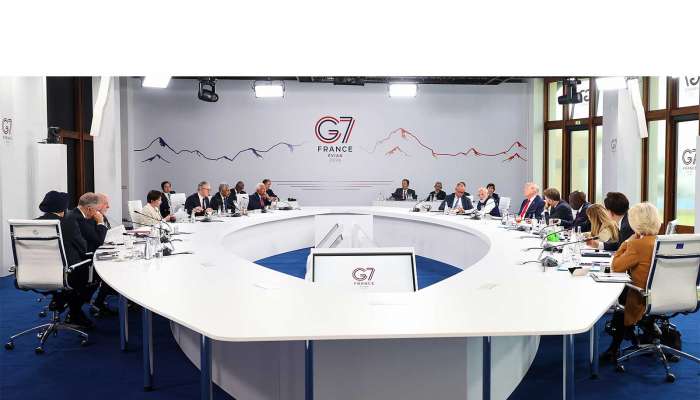
G7 Leaders Call for Resilient Global Growth, Stress Free Transit Through Strait of Hormuz
Translated from English, summarized and contextualized by DistantNews.
At a glance
News
Named sources
Context piece
- G7 leaders called for balanced, durable, and resilient global economic growth during their summit in Evian.
- They stressed the urgent need to restore free and safe transit through the Strait of Hormuz to mitigate negative impacts on the global economy.
- The statement also addressed supply chain pressures, particularly for energy, agricultural inputs, and fertilizers, and reaffirmed commitment to stable markets.
Leaders at the G7 Summit in Evian have issued a joint statement calling for a global economy that is more balanced, durable, and resilient. The group emphasized the critical importance of restoring free and safe passage through the Strait of Hormuz, a vital artery for global energy supplies, to alleviate economic uncertainty.
The statement highlighted the lingering effects of past shocks and structural shifts that continue to challenge global trade and investment. Leaders acknowledged that pressures on energy, agricultural inputs, and fertilizer supply chains are impacting industries, farmers, and households worldwide, especially in the most vulnerable nations. They underscored that a swift return to unimpeded transit through the Strait of Hormuz, without any charges, is imperative to mitigate these negative effects.
In addition to securing trade routes, the G7 reaffirmed its commitment to well-functioning, stable, and transparent markets for energy and other commodities. The leaders urged all nations to refrain from imposing arbitrary export restrictions, emphasizing the need for secure trade flows and uninterrupted energy trade amidst current geopolitical tensions. This call comes as the US and Iran are reportedly set to sign a Memorandum of Understanding (MoU) later this week, with U.S. President Trump suggesting the peace deal could reopen the Strait of Hormuz.
Looking forward, the G7 leaders stressed enhancing economic resilience through diversified supply chains, efficient energy systems, and closer cooperation between producers and consumers. They also encouraged oil-importing countries to maintain sufficient strategic petroleum reserves, aligning with International Energy Agency guidelines, to strengthen crisis-management mechanisms and stabilize energy markets during disruptions. The group also touched upon the need for reforms within the World Trade Organization.
We recognise that a swift return to free and safe transit through the Strait of Hormuz without any form of charges, and a lasting resolution to the conflict, are imperative to mitigate these negative impacts and support more balanced, durable and resilient global growth.
DistantNews Editorial
Originally published by Times of Oman in English. Translated, summarized, and contextualized by our editorial team with added local perspective. Read our editorial standards.
More Stories
From Our Blog

What Gets Lost (and Found) When News Is Translated

The Critical Role of Diaspora Media in Global News

What Travellers Should Know About Countries with Restricted Press

A Digital Nomad's Guide to Following Local News

How the Same Story Looks Different in Different Countries
