


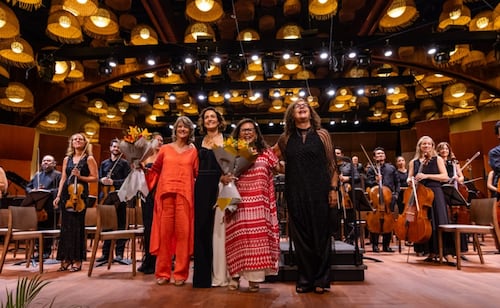
Gabriela Ortiz crafts symphony inspired by Red Queen's archaeological discovery
Translated from Spanish, summarized and contextualized by DistantNews.
At a glance
In-depth
Named sources
New plan
- Mexican composer Gabriela Ortiz premiered her symphonic poem "La Reina Roja" (The Red Queen) at the PAAX GNP Festival.
- The work is inspired by Adriana Malvido's book about the discovery of the Red Queen's tomb in Palenque 32 years ago.
- Ortiz's composition explores themes of archaeology, nature, spirituality, and the female figures involved in the discovery.
Mexican composer Gabriela Ortiz's new symphonic poem, "La Reina Roja" (The Red Queen), premiered at the PAAX GNP Festival, drawing inspiration from the archaeological discovery of the same name.
In this book, Adriana tells and narrates in a truly extraordinary way how Fanny López Jiménez, the archaeologist who intuits that there is a sarcophagus in Temple XIII. And she is the witness when the sarcophagus of the Red Queen is discovered.
Commissioned by the festival, the piece is based on Adriana Malvido's book, which chronicles the journalistic coverage of the Red Queen's tomb discovery 32 years ago in Palenque. Ortiz was captivated by the human element of the story: the intuition of archaeologist Fanny López Jiménez, who suspected a sarcophagus lay within Temple XIII, and her witnessing of the tomb's uncovering. The composer also cited Malvido's passionate narration as a key motivator.
The symphonic poem is structured in five interconnected movements. The first, "Luminiscencia en rojo" (Red Luminescence), evokes the dawn preceding the discovery. The second, "Geometrías de selva y piedra" (Geometries of Jungle and Stone), reflects Malvido's narrative and the ancient connection between nature and matter. "Cinabrio" (Cinnabar), the third movement, focuses on the red mineral that covered the sarcophagus, symbolizing its spiritual significance for the Maya culture and featuring visceral, ritualistic music.
We are going to go to another world. I ask you to be very open because we are going to go to the world of sensations, the world of images, the world of smells.
The fourth movement, "Rostro malaquita" (Malachite Face), alludes to the reconstruction of the Red Queen's mask from small malachite fragments, depicted through intricate sound fractals. The final section, "Tz'akab Ajaw," celebrates the discovery of the Red Queen, identified as the wife of Pakal "the Great." It also serves as a tribute to the women integral to the project: conductor Alondra de la Parra, author Adriana Malvido, and archaeologist Fanny López Jiménez.
This mineral was used to preserve not only the bones, but it had a spiritual meaning for the Maya culture. There you will hear a kind of ancestral rite, very visceral and strong music.
Festival artistic director Alondra de la Parra highlighted the importance of commissioning new musical and choreographic works at each PAAX GNP Festival edition. Ortiz encouraged the audience to be open to a journey into sensations, images, and scents, emphasizing the immersive nature of her composition.
She talks about how the mask of the Red Queen was reconstructed from small pieces of stone, of malachite. Imagine small fractals of sounds, small malachites that sound.
DistantNews Editorial
Originally published by El Universal in Spanish. Translated, summarized, and contextualized by our editorial team with added local perspective. Read our editorial standards.
More Stories

From Our Blog

What Press Freedom Means for the News You Read

What Gets Lost (and Found) When News Is Translated

The Critical Role of Diaspora Media in Global News

What Travellers Should Know About Countries with Restricted Press

A Digital Nomad's Guide to Following Local News
