


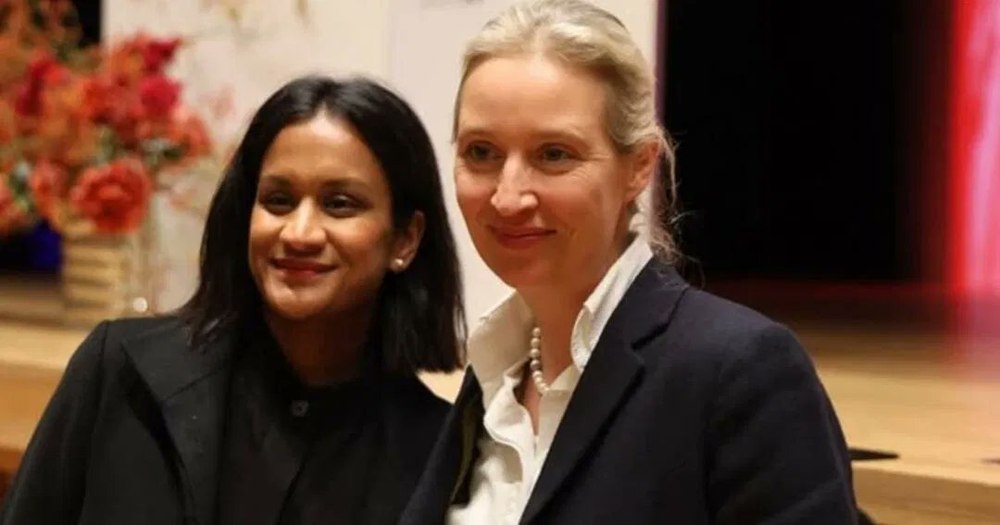
German far-right leader Weidel clashes with party branch over 'traditional family' manifesto
Translated from Romanian, summarized and contextualized by DistantNews.
At a glance
News
Named sources
Ongoing story
- Alice Weidel, co-leader of Germany's far-right AfD party, distanced herself from a regional party manifesto advocating for traditional families.
- Weidel, who lives in a civil partnership with another woman and raises two children, stated that modern reality differs and same-sex relationships should be treated equally.
- German Defense Minister Boris Pistorius warned against granting AfD members access to classified information due to concerns about their ties to Russia and potential threats to national security.
Alice Weidel, a prominent co-leader of Germany's Alternative for Germany (AfD) party, has publicly distanced herself from a manifesto adopted by a regional branch that exclusively promoted the traditional family model. The AfD's Saxony-Anhalt branch approved a document stating that a "complete family, consisting of mother, father, and children, represents the best foundation for a child's healthy development."
They can write whatever they want. I live differently. My children benefit from the best education and the best opportunities. Today we live in a completely different reality, which is why same-sex relationships should be treated as equal.
When questioned by journalists about this stance, Weidel, who is in a registered civil partnership with another woman and raises two children, responded decisively. "They can write whatever they want. I live differently," she stated. "My children benefit from the best education and the best opportunities. Today we live in a completely different reality, which is why same-sex relationships should be treated as equal."
When, as a politician, I speak of a social ideal – which is currently the traditional family – I can support it without any problem.
Despite this personal divergence, Weidel defended her party's general ideological line, asserting no contradiction between her political convictions and personal life. She argued that as a politician, she can support the traditional family as a social ideal without issue. This internal dispute follows Weidel and Tino Chrupalla's re-election as federal leaders of the AfD, a congress marked by large street protests and significant police mobilization.
It is enough to listen to the public statements of many AfD representatives. Their close ties to Vladimir Putin are undeniable, with suspicions of funding from Russia also existing. It is obvious that access to secret information must not be allowed to them.
Meanwhile, German Defense Minister Boris Pistorius issued a stern warning regarding the AfD's political ascent. In an interview with Bild, he strongly advocated against sharing classified information with potential regional ministers from the party. Pistorius expressed "maximum concern" over the possibility of the AfD gaining a majority in the Saxony-Anhalt state elections, emphasizing that his ministry is rigorously examining the criteria for granting access to state secrets. He cited the AfD representatives' public statements and their "undeniable" close ties to Vladimir Putin, along with suspicions of Russian funding, as reasons why access to secret information should be denied. Pistorius deemed the AfD's electoral success a "extremely dangerous signal" for German democracy.
a "extremely dangerous signal"
DistantNews Editorial
Originally published by Adevărul in Romanian. Translated, summarized, and contextualized by our editorial team with added local perspective. Read our editorial standards.
More Stories

From Our Blog

What Gets Lost (and Found) When News Is Translated

The Critical Role of Diaspora Media in Global News

What Travellers Should Know About Countries with Restricted Press

A Digital Nomad's Guide to Following Local News

How the Same Story Looks Different in Different Countries
