


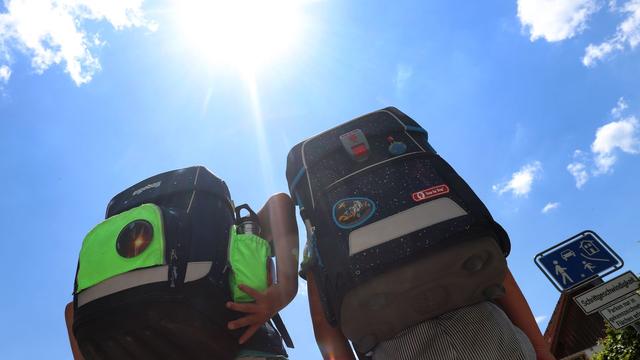
Germany: Heat Holiday Rules for Schools in Baden-Württemberg
Translated from German, summarized and contextualized by DistantNews.
At a glance
News
Sources not specified
Context piece
- Schools in Baden-Württemberg, Germany, can send students home early for "heat holidays" under specific conditions, as temperatures are predicted to reach up to 39 degrees Celsius.
- Decisions on granting "heat holidays" are made by individual school administrations in consultation with neighboring schools, rather than by a central ministry.
- While there's no uniform temperature threshold, schools are advised to consider giving holidays if the outdoor temperature reaches at least 25 degrees Celsius by 11 a.m., and not before the fourth class period.
As temperatures in Baden-Württemberg, Germany, are forecast to soar to potentially record-breaking highs of up to 39 degrees Celsius early next week, the question of "heat holidays" for students becomes relevant. In classrooms, especially those without adequate cooling, the heat can make learning extremely uncomfortable.
The Ministry of Education in Baden-Württemberg does not issue general directives on when students should receive "heat holidays." There is no nationwide temperature limit that automatically ends classes. Instead, individual school leaders, in coordination with nearby schools, are empowered to make these decisions, aiming for consistency where possible. School principals must balance the need for "heat holidays" against important academic events like scheduled tests, with make-up dates being arranged if classes are canceled.
Although no fixed rules exist, the ministry suggests schools consider granting "heat holidays" if the outdoor temperature reaches at least 25 degrees Celsius by 11 a.m. Such breaks should not occur before the fourth class period. The ministry emphasizes that the decision should prioritize students' physical well-being, taking into account specific local conditions.
For younger students in primary schools with extended care services, supervision must continue even if classes are dismissed early. Schools are obligated to provide a place for students to stay until their scheduled departure home if they rely on public transport or cannot walk home. Students in vocational schools and upper secondary levels are not eligible for "heat holidays," but schools must ensure they have access to drinking water. For teachers and other school staff, workplace regulations generally permit temperatures up to 26 degrees Celsius, with measures required to be taken above that point, becoming mandatory from 30 degrees Celsius.
the physical well-being of the students under consideration of the specific local conditions
DistantNews Editorial
Originally published by Die Zeit in German. Translated, summarized, and contextualized by our editorial team with added local perspective. Read our editorial standards.
More Stories



From Our Blog

What Gets Lost (and Found) When News Is Translated

How the Same Story Looks Different in Different Countries

The Critical Role of Diaspora Media in Global News

What Travellers Should Know About Countries with Restricted Press

A Digital Nomad's Guide to Following Local News
