

Germany's largest battery storage system launches near Leuna
Translated from German, summarized and contextualized by DistantNews.
At a glance
News
From a news agency
New plan
- Germany has inaugurated its largest battery storage system near Leuna, with a capacity of 250 megawatts and 500 megawatt-hours.
- The facility, built by Münch Energie, aims to store surplus wind and solar power, stabilizing the grid and reducing curtailment of renewable energy.
- This private, unfunded project is seen as a continuation of the region's energy history and a boost for economic development, with plans for further storage expansion in the state.
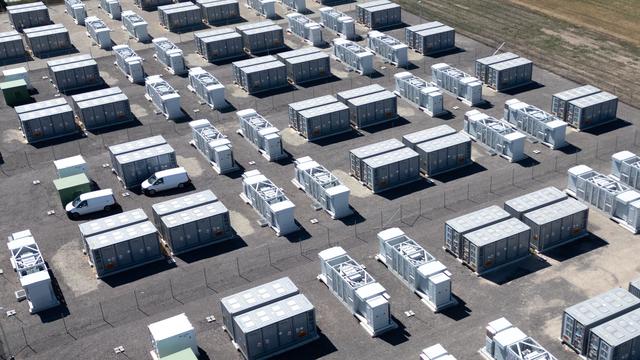
Germany's largest battery storage system has officially begun operations near Leuna, marking a significant step in the nation's energy transition. The facility, developed by Münch Energie, boasts a 250-megawatt capacity and can currently store 500 megawatt-hours of electricity, with plans to expand to 800 megawatt-hours by year's end.
For this flexibility, large storage systems are the key.
The primary function of this massive battery system is to absorb excess electricity generated by wind and solar farms, then feed it back into the grid during peak demand. This process is crucial for stabilizing power networks, which often struggle with the intermittent nature of renewable energy sources. By providing this flexibility, the storage system aims to prevent the curtailment of renewable energy production and enhance overall grid reliability.
Sachsen-Anhalt's Minister President Sven Schulze highlighted the importance of such large-scale storage solutions, stating they are key to managing the fluctuating energy supply from the state's abundant solar and wind resources. He emphasized that these systems strengthen energy security and contribute to a more stable power grid.
Sachsen-Anhalt already generates large amounts of electricity from sun and wind. Through storage, this energy can be made available more when it is needed. This strengthens supply security and makes our power grid more stable.
The project, completed in approximately six months, was entirely financed by private investment without any state subsidies. Company founder Mario Münch views the new energy infrastructure as a smart continuation of the region's industrial heritage, which historically relied on lignite mining. "Where electricity is cheap, safe, and green, that's where investments go," Münch stated, aiming to position the Leipzig/Halle region as a hub for long-term growth.
The region looks back on a long energy history. In the Leipzig area, lignite was mined for more than a century, many former open-cast mines have now been shut down and flooded. The development of new energy infrastructure is a very clever continuation of the story.
This development is part of a broader expansion of battery storage in Sachsen-Anhalt, with additional large-scale projects planned in Förderstedt and Wittenberg. These initiatives underscore the state's commitment to modernizing its energy infrastructure and attracting further economic investment.
Where electricity is cheap, safe, and green, that's where investments go.
DistantNews Editorial
Originally published by Die Zeit in German. Translated, summarized, and contextualized by our editorial team with added local perspective. Read our editorial standards.
More Stories

From Our Blog

What Gets Lost (and Found) When News Is Translated

How the Same Story Looks Different in Different Countries

The Critical Role of Diaspora Media in Global News

What Travellers Should Know About Countries with Restricted Press

A Digital Nomad's Guide to Following Local News
