


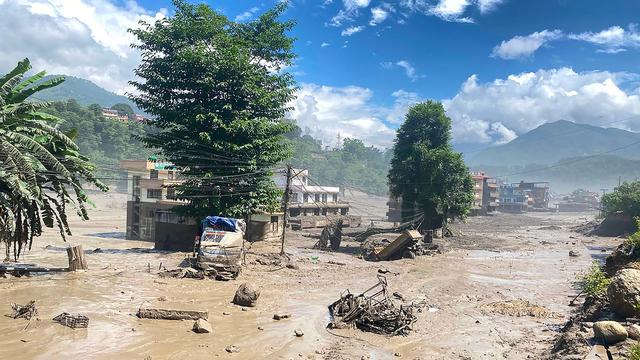
Glacier collapse triggers devastating flash flood in Nepal
Translated from German and summarized by DistantNews. Read the original for the full story.
At a glance
News
From a news agency
Outcome reported
- A massive flash flood in Nepal was caused by a glacier collapse on the Langtang Lirung mountain.
- The event, recorded as a 5.7 magnitude earthquake by monitoring networks, occurred when a section of the mountainside broke off and melted upon impact.
- Experts warn that similar events are a growing risk in the Himalayas due to melting glaciers and thawing permafrost, potentially exacerbated by climate change.
A catastrophic flash flood in Nepal, which devastated parts of the Langtang region, was triggered by the dramatic collapse of a glacier on the Langtang Lirung mountain. Experts have reconstructed the sequence of events, identifying the precise moment of the disaster.
The valley is very narrow and very steep. As a result, the water masses could pile up like this.
At 8:37 AM local time on a Wednesday morning, a significant portion of the mountainside, including a glacier, broke away from the north face of Langtang Lirung, a peak exceeding 7,200 meters. The immense energy released during the fall, estimated to be over 1,000 meters deep, caused the ice to melt almost instantaneously. The impact was so powerful that seismic networks registered it as a 5.7 magnitude earthquake.
Niels Hovius, head of Geomorphology at the GFZ Helmholtz Centre for Geosciences, explained that the flood's devastating force was amplified by the narrow and steep terrain of the valley. The resulting torrent of water and mud surged downwards at an estimated speed of 40 meters per second, or approximately 144 kilometers per hour. While the exact role of glacial lakes in the initial collapse remains unclear, Hovius believes the water primarily originated from the glacier itself.
Alarming is that there are glaciers and glacial lakes everywhere in the Himalayas. And there are all sorts of processes that ultimately have the same end result.
Hovius expressed alarm at the prevalence of glaciers and glacial lakes throughout the Himalayas, noting that various processes can lead to similar catastrophic outcomes. While he cautioned against definitively linking this specific event to climate change, he highlighted that melting glaciers, thawing permafrost, and rising zero-degree isotherms are increasing the risk of destabilization in high mountain regions worldwide, including the Himalayas, Andes, and Alps.
Glaciers are melting, permafrost is thawing, the zero-degree limit is rising - and the Himalayas are severely affected. These environmental conditions increase the risk of destabilizations.
About this summary
Originally published by Die Zeit in German. Translated, summarized, and contextualized automatically by DistantNews, with a note on how the source frames the story. Not individually reviewed before publishing. How this works.
More Stories


From Our Blog

What Gets Lost (and Found) When News Is Translated

How the Same Story Looks Different in Different Countries

The Critical Role of Diaspora Media in Global News

What Travellers Should Know About Countries with Restricted Press

A Digital Nomad's Guide to Following Local News
