


Global experts urge action on AI's unprecedented economic impact
Translated from Korean, summarized and contextualized by DistantNews.
At a glance
News
Sources not specified
Context piece
- Over 200 prominent economists and AI researchers, including 16 Nobel laureates, have issued a joint statement urging immediate action on AI policy.
- They warn that AI will bring unprecedented economic changes within the next decade, potentially exceeding the impact of the Industrial Revolution in speed and scale.
- The statement calls for proactive measures to ensure AI complements humans and benefits society, addressing risks like mass job displacement alongside opportunities for improved living standards.
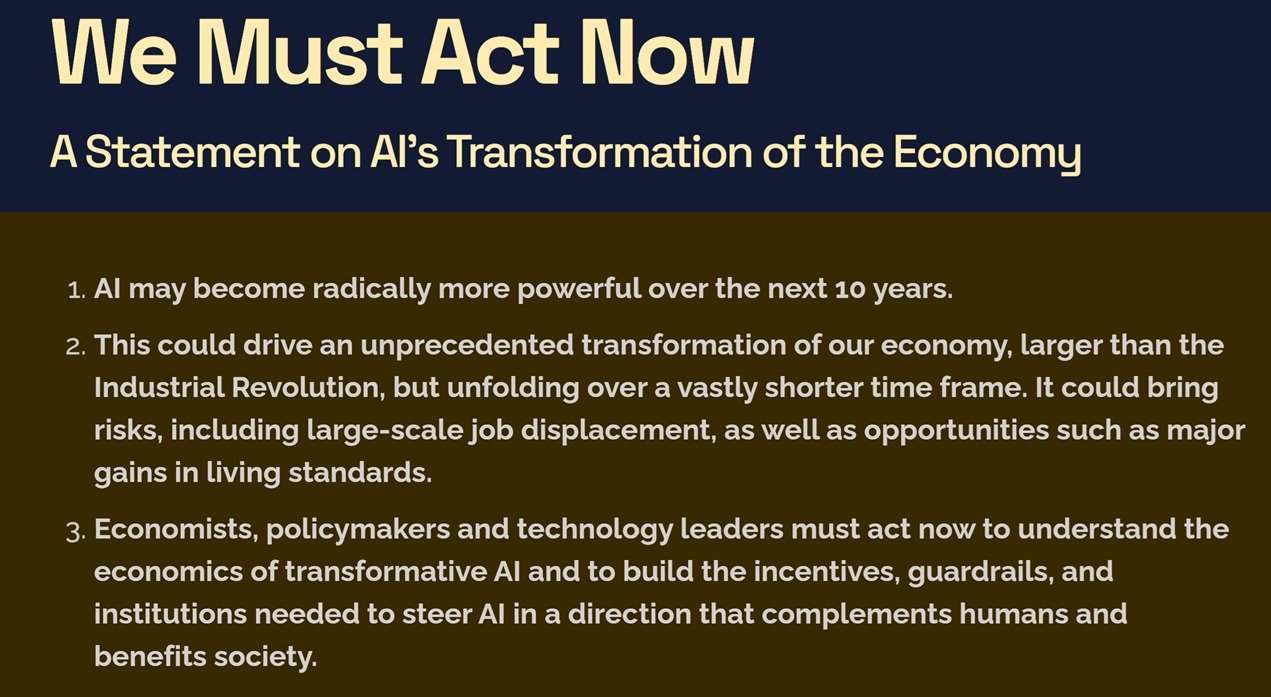
A group of over 200 leading economists and artificial intelligence researchers, including 16 Nobel laureates, have issued a joint statement warning of the profound and rapid economic transformations AI is expected to bring. The call to action, titled 'We Must Act Now,' emphasizes that AI's capabilities are advancing faster than our understanding of its economic implications. The signatories, from institutions like Stanford University, MIT, and Columbia University, urge policymakers, economists, and tech leaders to develop frameworks that guide AI's integration into society.
The statement highlights that AI could trigger more radical and powerful changes in the next decade than previously imagined, potentially surpassing the Industrial Revolution in both impact and the speed of its unfolding. While acknowledging the risks, such as large-scale job displacement, the researchers also point to significant opportunities for improving living standards. They stress the need for incentives, safeguards, and institutions to ensure that AI develops in a way that complements human abilities and serves the broader interests of society.
Notable signatories include Nobel laureates Michael Spence, Daron Acemoglu, Joseph Stiglitz, Paul Krugman, and former U.S. Federal Reserve Chair Ben Bernanke. Prominent figures from the tech industry, such as Josh Clark, co-founder of Anthropic; Eric Schmidt, former CEO of Google; Jeff Dean, Google's Chief Scientist; and Sarah Friar, CFO of OpenAI, also lent their names to the declaration. The initiative was spearheaded by professors Erik Brynjolfsson of Stanford University, Ajay Agrawal of the University of Toronto, and Anton Korinek of the University of Virginia.
Professor Brynjolfsson stated that AI's capabilities are evolving at a pace that outstrips our comprehension of its economic effects. He stressed the urgency of acting now to steer AI development towards complementing humans rather than merely mimicking them, and to foster prosperity for the many, not just a select few. The collective voice of these experts underscores the critical juncture humanity faces, calling for a proactive and collaborative approach to harness AI's potential while mitigating its inherent risks.
DistantNews Editorial
Originally published by Hankyoreh in Korean. Translated, summarized, and contextualized by our editorial team with added local perspective. Read our editorial standards.
More Stories


From Our Blog

What Gets Lost (and Found) When News Is Translated

The Critical Role of Diaspora Media in Global News

What Travellers Should Know About Countries with Restricted Press

A Digital Nomad's Guide to Following Local News

How the Same Story Looks Different in Different Countries
