


Global TV Shipments Decline, But OLED Market Sees Strong Growth
Translated from Korean, summarized and contextualized by DistantNews.
At a glance
News
Documents & data
Context piece
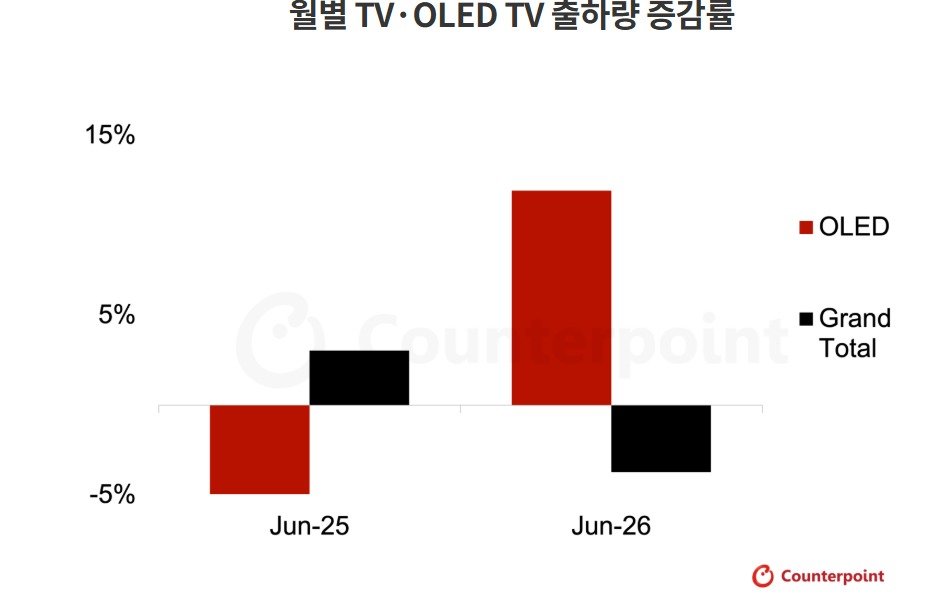
- Global TV shipments fell 4% year-on-year in June, with the second quarter showing a slight 0.4% decline, maintaining last year's level.
- OLED TV shipments, however, surged 12% in June and 20% in the second quarter, marking a period of "solitary growth."
- In the LCD TV market, TCL and Samsung are in a tight race, with market shares at 13.8% and 13.7% respectively in June.
Global TV shipments experienced a downturn in June, decreasing by 4% compared to the same month last year. The second quarter as a whole saw a marginal 0.4% decline in shipments, effectively holding steady at the previous year's levels. However, the market for Organic Light-Emitting Diode (OLED) TVs bucked this trend, with shipments rising 12% in June and a significant 20% over the entire second quarter, continuing its "solitary growth" trajectory.
The dip in June shipments is attributed less to a reduction in actual demand and more to a pull-forward effect. Promotions for events like the World Cup likely shifted demand into April, resulting in a subsequent decrease in June shipments. Among brands, Philips, Samsung Electronics, and TCL recorded increased shipments. In contrast, Hisense, Huawei, and Changhong, among others, saw declines.
In recent years, OLED TVs have been losing ground to relatively cheaper Mini LED TVs in the ultra-premium market. Consumers compared larger-screen Mini LED TVs with relatively smaller OLED TVs at similar price points, and a significant number chose Mini LED.
Philips' growth appears linked to the release of new OLED TVs, such as the OLED811 and OLED761, and mid-range QD LCD TVs like the PQS9001. Meanwhile, the LCD TV sector remains a fiercely competitive arena for Samsung Electronics and TCL. Samsung has expanded its product range with new Mini LED lineups, including the M80H and M70H, alongside the S95H and R95H models. TCL is pushing ahead with its Super Quantum Dot (SQD) Mini LED TVs, such as the X11L, C8L, and C7L series.
Samsung and TCL are locked in direct competition across all price points, from entry-level to ultra-premium, utilizing Mini LED and RGB Mini LED technologies. As of June, their LCD TV market share was nearly identical, with TCL at 13.8% and Samsung at 13.7%, a difference of just 0.1 percentage points. Notably, the two brands are pursuing different technological paths: Samsung is extending its RGB backlight-based TVs across its lineup, while TCL is limiting its RGB MiniLED to premium, large-screen models, positioning SQD MiniLED at the top of its proprietary technology stack. This divergence creates a competitive landscape where both brands vie for market dominance with distinct technological approaches.
LG Display is countering this trend by releasing lower-priced OLED TV panels, and there is a sufficient possibility of winning back some of those customers.
DistantNews Editorial
Originally published by Dong-A Ilbo in Korean. Translated, summarized, and contextualized by our editorial team with added local perspective. Read our editorial standards.
More Stories



From Our Blog

What Gets Lost (and Found) When News Is Translated

The Critical Role of Diaspora Media in Global News

What Travellers Should Know About Countries with Restricted Press

A Digital Nomad's Guide to Following Local News

How the Same Story Looks Different in Different Countries
