


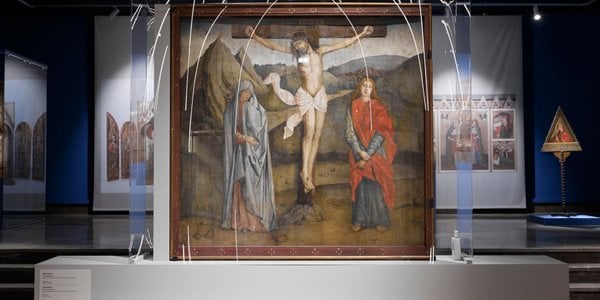
Gothic art from the Carpathians showcased in Krakow, featuring 'Madonna of Uzhhorod' from the Louvre
Translated from Polish, summarized and contextualized by DistantNews.
At a glance
In-depth
Sources not specified
Context piece
- An exhibition in Krakow explores the Gothic art of the Carpathian region, highlighting its role as a cultural bridge in medieval Europe.
- The show features works from across the region, including a significant loan from the Louvre Museum in Paris.
- It aims to reveal the interconnectedness of art and traditions across medieval Hungary, Poland, and surrounding territories.
Krakow's National Museum is hosting "Gothic in the Carpathians," a pioneering exhibition that re-examines the region's artistic heritage and its role as a cultural connector in medieval Europe. Curator Dr. Wojciech Marcinkowski emphasizes that mountains like the Carpathians did not divide but rather united people and artistic trends.
"The Carpathians, like other mountains, did not divide but connected. The same workshops operated on both sides of the mountains, works of art were sent from one side of the mountain range to the other; and new artistic tendencies penetrated in both directions," Marcinkowski explained. A striking example of this connection is a 15th-century Crucifixion scene from Brasov, Romania, painted by a master depicting the Southern Carpathian landscape.
The exhibition's centerpiece is the "Madonna of Uzhhorod," a 15th-century polychrome linden wood sculpture on loan from the Louvre Museum in Paris. This standing Madonna and Child, with Mary holding an apple symbolizing redemption, is a rare example of a motif that first appeared in France during the Middle Ages.
"Gothic in the Carpathians" showcases works from present-day Poland, Czech Republic, Austria, Slovakia, Hungary, and Romania, alongside pieces from Western European collections. The exhibition's architectural design, featuring neon arches reminiscent of Gothic cathedral vaults, creates a contemporary yet historically resonant atmosphere, making it one of the few major medieval art exhibitions in Polish museums in recent decades.
The Carpathians, like other mountains, did not divide but connected. The same workshops operated on both sides of the mountains, works of art were sent from one side of the mountain range to the other; and new artistic tendencies penetrated in both directions.
DistantNews Editorial
Originally published by Rzeczpospolita in Polish. Translated, summarized, and contextualized by our editorial team with added local perspective. Read our editorial standards.
More Stories


From Our Blog

What Gets Lost (and Found) When News Is Translated

The Critical Role of Diaspora Media in Global News

What Travellers Should Know About Countries with Restricted Press

A Digital Nomad's Guide to Following Local News

How the Same Story Looks Different in Different Countries
