


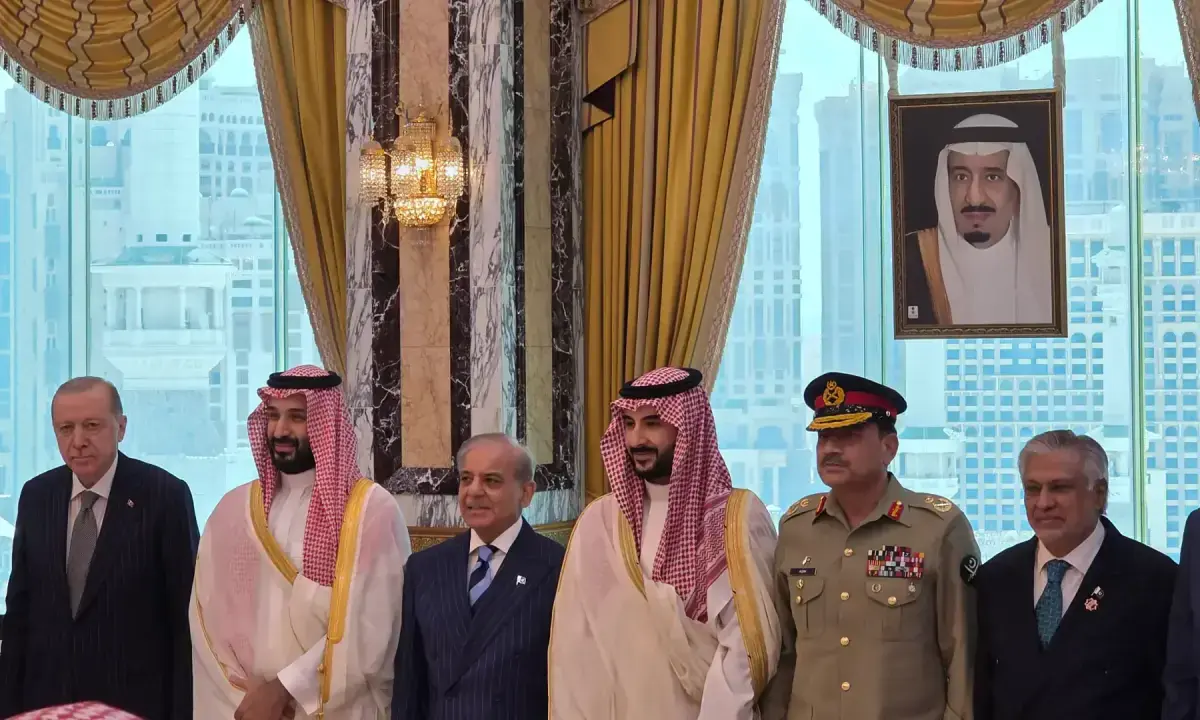
Gulf's Security Architecture Evolves with New Pakistan-Saudi-Turkiye Defense Pact
Translated from English, summarized and contextualized by DistantNews.
At a glance
News
Named sources
New plan
- Pakistan, Saudi Arabia, and Turkiye signed a joint defense agreement, reflecting a shift in the Gulf's security architecture.
- The pact aims to supplement, not replace, the US security umbrella by institutionalizing regional defense planning and cooperation.
- It emerges amid heightened regional instability, including maritime security threats and evolving US priorities in the Middle East.
A new joint defense agreement signed by Pakistan, Saudi Arabia, and Turkiye marks a significant, albeit gradual, reordering of the Gulf's security landscape. While not an Islamic equivalent of NATO, the Makkah Joint Defence Agreement signals a growing need for regional security mechanisms as confidence in traditional arrangements, particularly US guarantees, faces unprecedented strain.
For decades, the Gulf's security largely depended on a bargain where the United States ensured regional stability and protected maritime trade. However, recent crises have exposed the limitations of this arrangement. Attacks on energy facilities, disruptions to shipping, uncertainty over Washington's shifting regional focus, and the prolonged confrontation with Iran have convinced Gulf capitals that they need security beyond exclusive reliance on the US.
The Pakistan-Saudi-Turkiye pact is intended to supplement, rather than replace, the American security umbrella. It seeks to build upon existing military relationships, institutional familiarity, and political trust among the three nations. The agreement is fundamentally defensive, aiming to institutionalize mutual defense planning, intelligence cooperation, joint training, and coordinated responses to common threats, while preserving each participant's sovereign control over the use of force.
This development follows months of heightened regional instability. Events such as the Iran-US-Israel tensions, disruptions in the Strait of Hormuz, Houthi actions in the Red Sea, and concerns over the vulnerability of maritime energy routes have underscored the need for such a pact. Saudi Arabia's recent initiative to form a multinational maritime coalition further reflects this evolving strategic thinking. The defense pact is seen as a broader political and military expression of this changing security architecture.
While formally a trilateral agreement, the contributions are not equal. Saudi Arabia provides the crucial geography, financial resources, and the strategic imperative that necessitated the arrangement. The agreement aims to bolster regional security by fostering cooperation among countries with shared interests and long-standing ties, adapting to a complex geopolitical environment.
DistantNews Editorial
Originally published by Dawn in English. Translated, summarized, and contextualized by our editorial team with added local perspective. Read our editorial standards.
More Stories

From Our Blog

What Gets Lost (and Found) When News Is Translated

The Critical Role of Diaspora Media in Global News

What Travellers Should Know About Countries with Restricted Press

A Digital Nomad's Guide to Following Local News

How the Same Story Looks Different in Different Countries
