


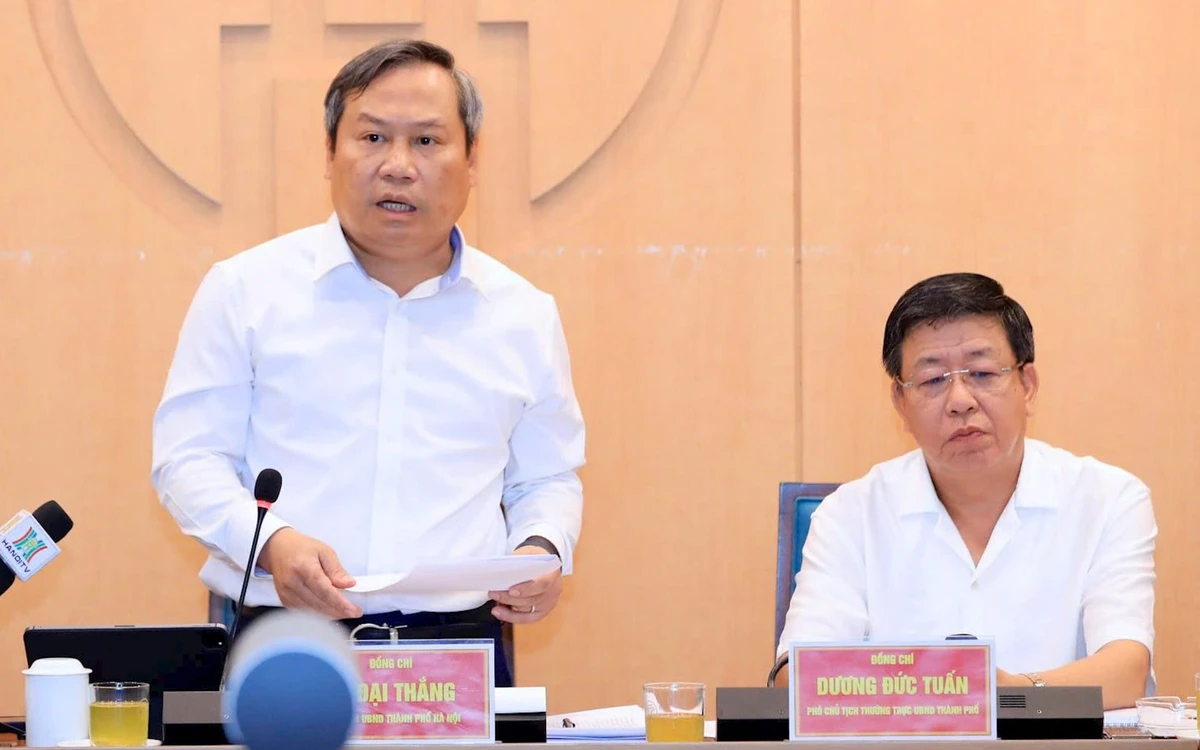
Hanoi Chairman: 'We won't let residents face prolonged temporary housing like in past projects'
Translated from Vietnamese, summarized and contextualized by DistantNews.
At a glance
News
Sources not specified
Context piece
- Hanoi Chairman Vu Dai Thang acknowledged significant challenges in achieving the city's double-digit economic growth target for 2026 due to complex global and domestic economic conditions.
- The city faces pressures from inflation, rising material costs, and limited business resilience, despite an increase in new business registrations.
- To meet growth targets, Hanoi will prioritize investment in key infrastructure projects and accelerate public fund disbursement, with slow-disbursing localities risking capital reallocation.
Hanoi Chairman Vu Dai Thang has highlighted the considerable challenges facing the capital in achieving its ambitious double-digit economic growth target for 2026. Speaking at a recent meeting, Thang noted that complex global and domestic economic conditions, including inflationary pressures, volatile material prices, and financial market instability, are directly impacting economic recovery and growth.
While the number of newly established businesses has increased, it has not met the city's development expectations. Thang stressed the need for objective assessments of achievements, identification of bottlenecks, and concrete solutions to overcome difficulties. "Even with our utmost effort in the final month of the second quarter, the projected growth will only hover around 9%. This is immense pressure," Thang stated.
Beyond internal economic hurdles, Hanoi is contending with external factors such as rising costs for materials, electricity, water, and logistics, alongside increased labor expenses. The resilience of businesses remains limited, with a significant number still facing dissolution.
Even with our utmost effort in the final month of the second quarter, the projected growth will only hover around 9%. This is immense pressure.
To propel growth, Hanoi will assign specific targets to various departments, sectors, and localities. The development and construction sector is identified as the primary growth engine. The chairman urged for accelerated disbursement of public investment capital, particularly for strategic infrastructure like Ring Road 4, Ring Road 2.5, National Highway 6, Red River bridges, and metro lines. He warned that localities with slow disbursement will have their funds reallocated to more capable units.
The city is also advancing large-scale strategic projects, including the Red River Scenic Avenue, an International Sports Complex, a Digital Technology and Mixed-Use Park, and a Medical Complex. Careful preparation for land clearance and resettlement is crucial to prevent prolonged temporary housing for residents, a lesson learned from past projects.
Localities that disburse funds slowly will have their capital withdrawn and reallocated to units with better disbursement capabilities.
DistantNews Editorial
Originally published by Tuổi Trẻ in Vietnamese. Translated, summarized, and contextualized by our editorial team with added local perspective. Read our editorial standards.
More Stories


From Our Blog

What Gets Lost (and Found) When News Is Translated

The Critical Role of Diaspora Media in Global News

What Travellers Should Know About Countries with Restricted Press

A Digital Nomad's Guide to Following Local News

How the Same Story Looks Different in Different Countries
