


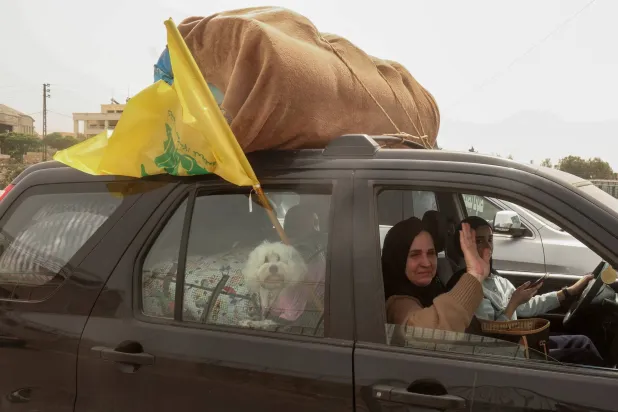
Hezbollah Official Says Lebanon-Israel Talks 'Do Not Concern Us'
Summarized and contextualized by DistantNews.
TLDR
- Internal divisions within Yemen's Houthi movement are intensifying due to competition for influence and resources, analysts and local sources report.
- Recent clashes between Houthi commanders, including a significant gunfight in Jabal Ras district, highlight weaknesses in managing internal disputes and declining trust in Houthi institutions.
- Analysts attribute the growing chaos to the group's isolation, leadership constraints, and widespread weapon ownership, leading to increased violence linked to personal disputes and land conflicts.
Asharq Al-Awsat's reporting on the escalating internal strife within Yemen's Houthi movement paints a concerning picture of a group grappling with deep-seated divisions. The analysis, drawing from insights from analysts and local sources, suggests that competition over influence and resources is intensifying, exacerbated by growing isolation and public discontent. This internal friction is manifesting in increasingly frequent and visible clashes among the group's own commanders, undermining its cohesion and operational capacity.
have become more frequent and visible, reflecting the accumulation of competing power networks formed during years of war.
The incident in Jabal Ras district, where a dispute between a Houthi-appointed security chief and a field commander erupted into a gunfight, serves as a stark example of the breakdown in internal control mechanisms. The use of heavy weaponry in a populated area, resulting in casualties on both sides and injuring a civilian, underscores the volatile nature of these conflicts. Such episodes are not isolated but represent a broader pattern of instability affecting various Houthi-controlled provinces.
Political researcher Salah Ali Salah points out that these conflicts are becoming more frequent and visible, reflecting the proliferation of competing power networks that have emerged during years of war. These networks have reshaped the internal hierarchy of the Houthi movement, weakening traditional tribal and social structures that once provided support or benefit. The shift of tensions from the periphery to the core of the movement, driven by competition for authority and resources, necessitates constant intervention from senior leadership to contain them.
are increasingly shifting from the periphery into the core of the movement, with disputes among supervisors and commanders driven by competition over authority, resources and influence.
Analyst Bassem Mansour links the growing chaos to the movement's isolation and the constraints faced by its leadership. Preoccupied with military and regional developments, and operating under the constant threat of Israeli targeting, senior Houthi figures have less capacity to manage internal rivalries effectively. This vacuum allows field commanders to act more impulsively, often in response to public resentment or personal disputes, further fueling the cycle of violence. The article also notes instances of violence stemming from personal disputes, such as land conflicts, which are amplified by widespread weapon ownership, creating a dangerous environment where lawlessness can easily take root.
Senior figures, he said, are preoccupied with military and regional developments and often operate in secrecy for fear of Israeli targeting, leaving field commanders to act impulsively in the face of public resentment.
DistantNews Editorial
Originally published by Asharq Al-Awsat. Summarized and contextualized by our editorial team with added local perspective. Read our editorial standards.
More Stories
From Our Blog

What Gets Lost (and Found) When News Is Translated

The Critical Role of Diaspora Media in Global News

What Travellers Should Know About Countries with Restricted Press

A Digital Nomad's Guide to Following Local News

How the Same Story Looks Different in Different Countries
