


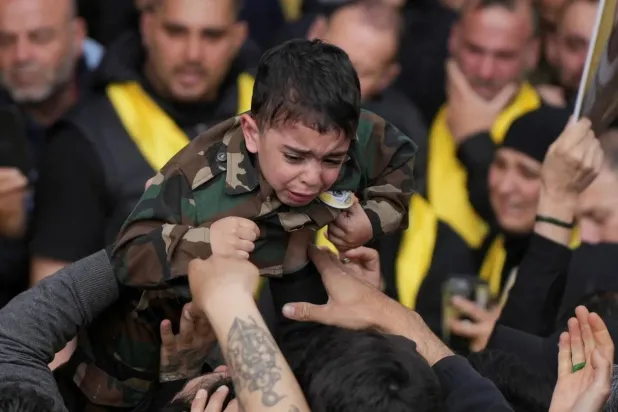
Hezbollah Threatens to Derail Israel Talks, Invokes 1983 Scenario
Summarized and contextualized by DistantNews.
TLDR
- Hezbollah is threatening to derail Lebanon's direct negotiation talks with Israel, warning of a repeat of the 1983 May 17 accord's failure.
- The group argues that a broad national consensus is lacking for such negotiations.
- Observers note that current regional dynamics differ significantly from those in 1983, suggesting Hezbollah's leverage may be limited.
Hezbollah has escalated its opposition to the Lebanese government's pursuit of direct negotiations with Israel, issuing stark warnings that the process could collapse and mirror the fate of the 1983 May 17 accord. The powerful Shiite group insists that any such talks require a comprehensive national consensus, which it claims is currently absent. This stance positions Hezbollah as a significant obstacle, potentially leveraging its influence to undermine the government's diplomatic efforts.
A large segment rejects the authorities’ path, and it was this segment, along with national forces, that brought down the May 17 accord, and it will not allow the experience to be repeated.
The historical parallel drawn by Hezbollah refers to the US-brokered peace treaty between Lebanon and Israel signed on May 17, 1983. This accord aimed to establish security arrangements, facilitate an Israeli withdrawal, and regulate the shared border following Israel's 1982 invasion. However, it was ultimately abandoned in March 1984 due to widespread domestic opposition from various Lebanese factions and strong Syrian rejection, highlighting the complex political landscape of the time.
Today, regional dynamics have changed. Hezbollah no longer has strategic depth, and its capabilities are very limited.
Despite Hezbollah's fierce rhetoric, some analysts and political figures, such as MP Salim Sayegh of the Kataeb Party, argue that the current geopolitical context is vastly different from 1983. Sayegh contends that Hezbollah's strategic depth has diminished and its capabilities are more constrained. He suggests that any attempt to disrupt the process through public unrest could backfire, alienating the Lebanese populace and uniting them behind a decisive government response.
Any misstep in the street would turn the entire Lebanese public against it.
Anger and threats have rippled through supporters of Amal and Hezbollah following the circulation of images depicting a meeting between Lebanese and Israeli ambassadors in Washington. Hezbollah MP Hassan Fadlallah reiterated the group's rejection of the government's path, emphasizing that a significant segment of the population, including the Shiite community, opposes direct negotiations. He asserted that this segment's role cannot be bypassed, underscoring Hezbollah's determination to prevent a repetition of the May 17 accord's collapse.
The army knows the terrain, both land and people. What it lacked was a clearly defined battle. No army can throw itself into an open-ended conflict. But if Hezbollah chooses chaos and strife, it will face a cohesive army and a united people.
DistantNews Editorial
Originally published by Asharq Al-Awsat. Summarized and contextualized by our editorial team with added local perspective. Read our editorial standards.
More Stories

From Our Blog

What Gets Lost (and Found) When News Is Translated

The Critical Role of Diaspora Media in Global News

What Travellers Should Know About Countries with Restricted Press

A Digital Nomad's Guide to Following Local News

How the Same Story Looks Different in Different Countries
