


Highway 'Master Builder Manole': Causes of Disaster on A10 and Authorities' Solutions
Translated from Romanian, summarized and contextualized by DistantNews.
At a glance
News
Sources not specified
Ongoing story
- Traffic on Lot 4 of the A10 Sebeș-Turda highway in Romania was restricted starting July 7 due to ground and asphalt failure.
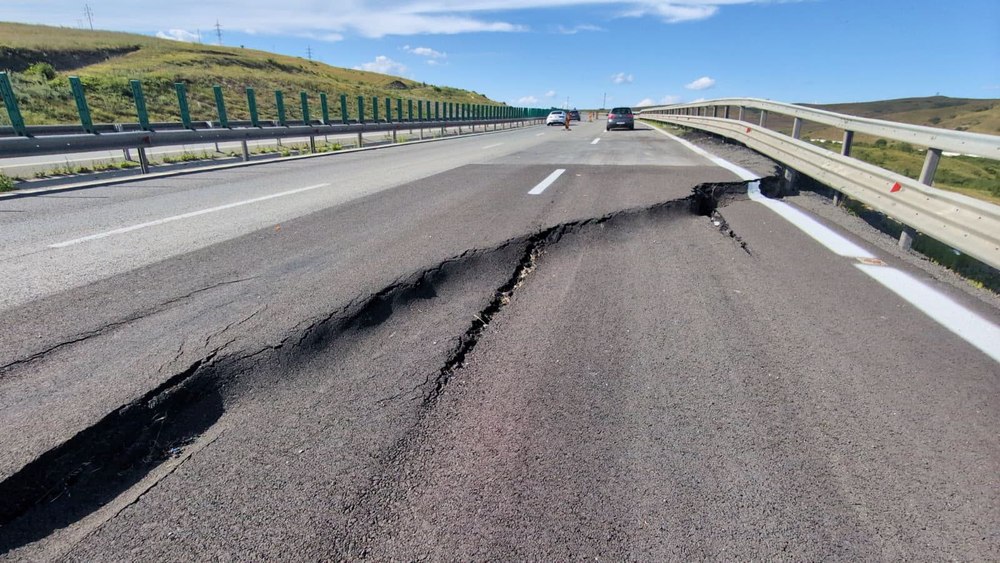
- The affected section, near kilometer 66+400 in Cluj County, saw the first lane completely destroyed and the embankment slide over 50 meters.
- Authorities are discussing solutions, with a state secretary proposing to keep traffic on the highway instead of diverting it to a national road.
Traffic on Lot 4 of the A10 Sebeș-Turda highway in Romania has been restricted since Tuesday, July 7, following a significant failure of the asphalt and embankment near kilometer 66+400 in Cluj County. The first lane of the highway was completely destroyed, with the crack extending into the second lane. The adjacent embankment also slid over 50 meters, dragging the protective barriers with it.
Drivers traveling on the Sebeș - Turda Highway should not be diverted to the national road. There are civilized solutions for maintaining traffic on the highway. I do not agree with CNAIR's solution.
Ionut Ciurea, president of the Pro Infrastructura Association, and Alin Șerbănescu, spokesperson for the National Company for Road Infrastructure Administration (CNAIR), discussed the causes of the degradation and potential solutions. The affected section, built by the Austrian company Porr and inaugurated in 2018, has a history of recurring issues, with degradations reported in 2023, 2024, and early this year.
When the possibility of maintaining traffic on the highway under safe conditions exists, it must be the first option analyzed. Taking traffic off the highway for about 17 km means longer travel times, discomfort for drivers, and additional accident risks.
CNAIR announced that traffic would be restricted between kilometers 52+800 and 70+000 on the Unirea-Turda direction. Traffic will be diverted from the Unirea Road Node onto DN1, rejoining the highway at the Turda Road Node. The Regional Directorate of Roads and Bridges Cluj is intervening urgently due to the worsening instability in the area.
I proposed to CNAIR and the Romanian Police a solution that allows traffic to remain on the highway, diverting traffic to the other direction of travel and organizing bidirectional traffic on about 2.5 km, strictly in the affected area.
However, Horațiu Cosma, State Secretary in the Ministry of Transport, has proposed an alternative solution. He disagrees with CNAIR's plan to divert traffic entirely to the national road, which would add approximately 17 kilometers to the journey and increase risks. Cosma suggests keeping traffic on the highway by organizing bidirectional circulation on a 2.5-kilometer stretch in the affected zone, using a median crossing and a removable median barrier. He believes this approach is safer and more civilized, prioritizing the convenience and safety of drivers.
You cannot say it is a hidden defect.
DistantNews Editorial
Originally published by Adevărul in Romanian. Translated, summarized, and contextualized by our editorial team with added local perspective. Read our editorial standards.
More Stories

From Our Blog

What Gets Lost (and Found) When News Is Translated

The Critical Role of Diaspora Media in Global News

What Travellers Should Know About Countries with Restricted Press

A Digital Nomad's Guide to Following Local News

How the Same Story Looks Different in Different Countries
