


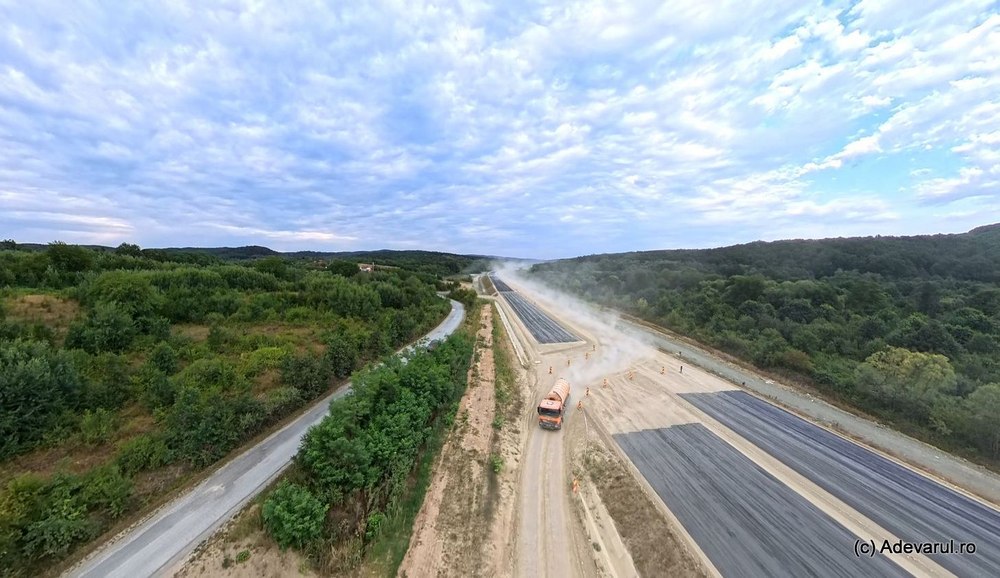
Highway with tunnels in western Romania nears final stages: paving begins, beam installation starts
Translated from Romanian, summarized and contextualized by DistantNews.
At a glance
News
Sources not specified
Ongoing story
- Construction on Romania's Lugoj-Deva highway, featuring two tunnels, is nearing its final stages.
- Workers are preparing for asphalt paving and are close to completing the breakthrough of the main tunnel's first gallery.
- The project involves over nine kilometers built from scratch in a challenging, hilly terrain.
The construction of the Lugoj-Deva highway in western Romania, notable for its extensive tunnel system, is advancing towards its final execution phases. Builders are actively preparing the ground for asphalt paving and are on the verge of completing the breakthrough for the first gallery of the main tunnel.
Work on the Holdea–Margina section, spanning over nine kilometers constructed from the ground up, began in 2024. This segment is characterized by two tunnels with a combined length of over 4.5 kilometers across four galleries. The initial layer of primer for asphalt paving is being applied from Holdea towards Margina, over a stabilized cement-bound aggregate foundation layer.
According to the Regional Directorate for Road and Bridge Management (DRDP), this priming operation is crucial for reducing rapid water evaporation from the foundation, preventing cracks, and ensuring optimal conditions for subsequent work. The entire section between Holdea in Hunedoara County and Margina in Timiș County is approximately 13.5 kilometers long.
Builders are nearing the completion of the main tunnel's galleries. The second tube measures 1,985 meters, while the first is 1,825 meters. Approximately 130 meters remain to be excavated for one gallery and less than 300 meters for the other. Tunnel excavation has proceeded from multiple points, with workers advancing one to two meters per day at each front, depending on geological conditions.
The project navigates difficult terrain, including clayey marl, clay, and fractured rock, with some areas lying only 10–12 meters below the surface. Excavation involves consolidating the tunnel faces and walls with anchors, metal nets, and shotcrete, while "umbrellas" of micropiles are installed in unstable zones to prevent collapses.
DistantNews Editorial
Originally published by Adevărul in Romanian. Translated, summarized, and contextualized by our editorial team with added local perspective. Read our editorial standards.
More Stories


From Our Blog

What Gets Lost (and Found) When News Is Translated

The Critical Role of Diaspora Media in Global News

What Travellers Should Know About Countries with Restricted Press

A Digital Nomad's Guide to Following Local News

How the Same Story Looks Different in Different Countries
