


Himalayan Rivers Worsen Due to Climate Change, Leading to More Floods and Disasters
Translated from Korean and summarized by DistantNews. Read the original for the full story.
At a glance
News
Sources not specified
Outcome reported
- Climate change is causing Himalayan glaciers to melt at twice the global average rate, leading to more frequent and severe floods and river instability.
- A 40-year study found that Himalayan rivers are becoming more erratic, with increased meandering, faster flow, and more frequent channel changes.
- These changes threaten water security for billions and increase the risk of damage to infrastructure and communities in the region.
Himalayan rivers are becoming increasingly volatile due to climate change, leading to a heightened risk of floods and disasters, according to a recent study. The 'water towers of Asia,' home to the world's largest glaciers outside the polar regions, are melting at an accelerated pace, roughly double the global average since the 1980s.
A comprehensive study published in the journal 'Science' analyzed 40 years of data on river systems in the Himalayas. Researchers tracked 1,582 kilometers of river channels across three major upper basins from 1980 to 2020. Their findings indicate that the rivers are exhibiting more erratic behavior, characterized by increased meandering, faster flow rates, and more frequent channel shifts and avulsions (where a river channel breaks or changes course).
Specifically, the study found that the 'sinuosity migration rate' of the rivers increased by 33% over the 40-year period, while the 'lateral migration speed' nearly doubled. The frequency of channel disconnection, change, and splitting also rose significantly, by 115%, 77%, and 97%, respectively. The overall index measuring the planform changes of river channels doubled during this period, with the time it took for rivers to move decreasing by 40%.
This acceleration in river dynamics is linked to 'cryosphere degradation' caused by global warming. As temperatures rise, glaciers and permafrost melt, increasing the volume of water and sediment carried by rivers. The thawing of permafrost along riverbanks also weakens their stability, exacerbating erosion. Unlike rivers in the Arctic, where vegetation growth can help stabilize thawing permafrost, the sparse vegetation in the Himalayas offers little such support.
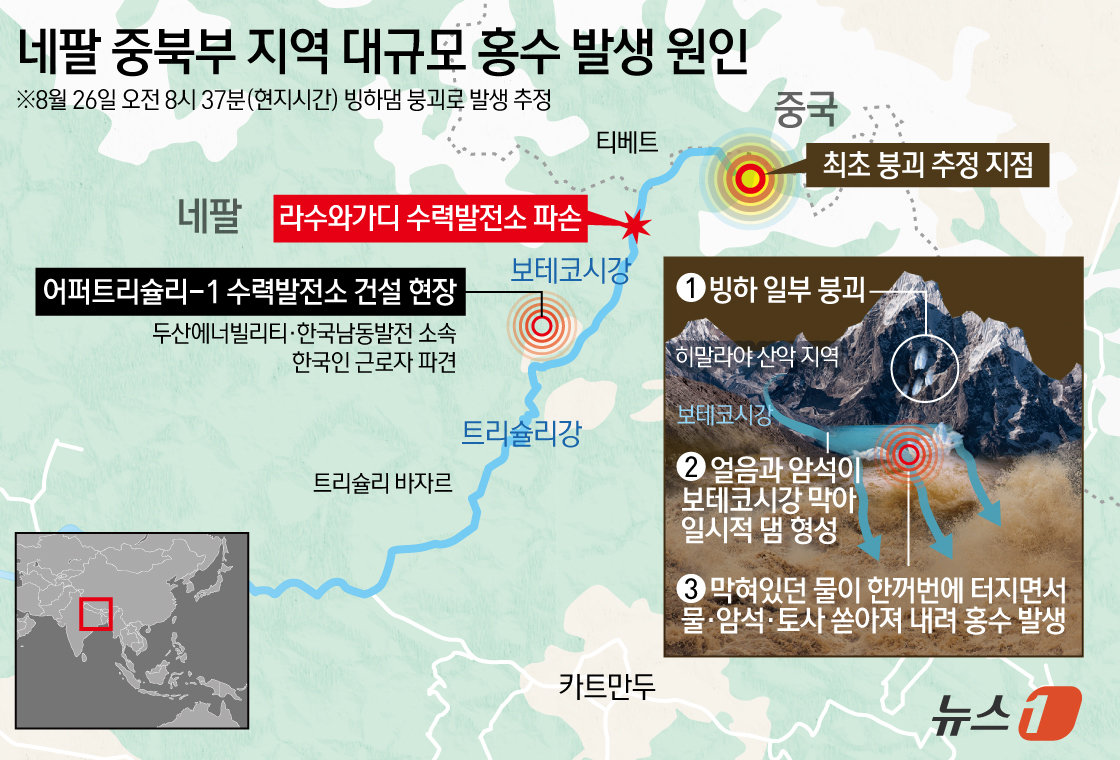
Researchers warn that these increasingly unstable rivers have severe implications for water security, flood management, sediment-related disasters, and the integrity of infrastructure along riverbanks. Recent events, such as glacial lake outburst floods (GLOFs) in Nepal and Pakistan, underscore the growing danger. The study's lead author emphasized the need to incorporate the interaction between climate and rivers into adaptation strategies for the billions who rely on Himalayan water resources.
The acceleration of river dynamics confirmed in this study has significant implications for the billions of people who depend on Himalayan water sources. Climate-river interactions must be reflected in adaptation strategies across the region.
About this summary
Originally published by Hankyoreh in Korean. Translated, summarized, and contextualized automatically by DistantNews, with a note on how the source frames the story. Not individually reviewed before publishing. How this works.
More Stories


From Our Blog

What Gets Lost (and Found) When News Is Translated

The Critical Role of Diaspora Media in Global News

What Travellers Should Know About Countries with Restricted Press

A Digital Nomad's Guide to Following Local News

How the Same Story Looks Different in Different Countries
