


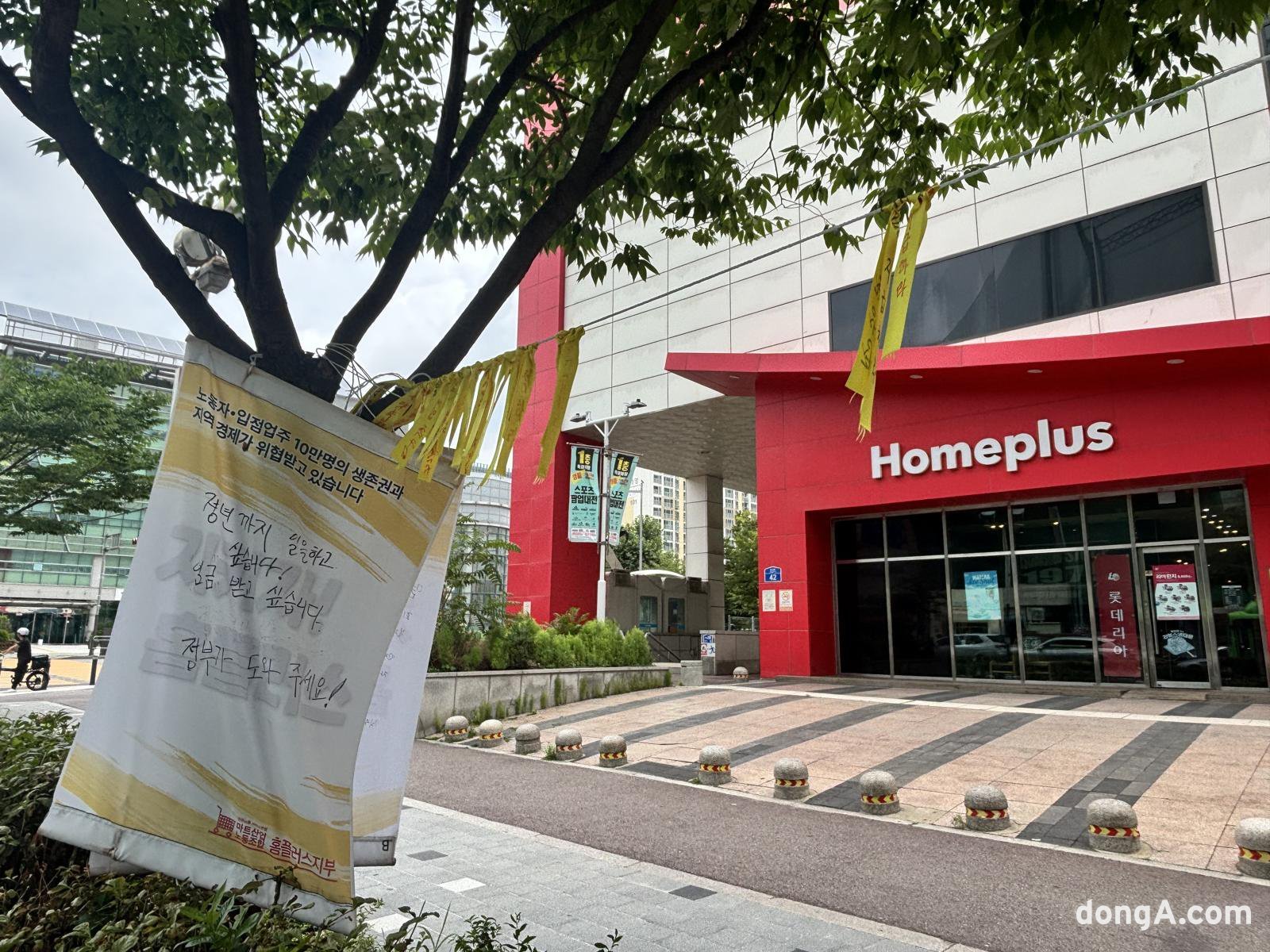
Homeplus Faces Bankruptcy, Threatening 12,000 Jobs Amid Criticism of MBK Partners
Translated from Korean, summarized and contextualized by DistantNews.
At a glance
News
Sources not specified
Under investigation
- Homeplus faces bankruptcy after the Seoul Rehabilitation Court terminated its receivership proceedings due to failure to secure 200 billion won in operating funds.
- Labor unions and politicians are raising concerns about tens of thousands of job losses and criticizing the private equity firm MBK Partners for alleged irresponsibility and asset stripping.
- The court allowed 14 days for Homeplus to secure funds and file an appeal, otherwise, its assets will face enforcement actions.
Homeplus, a major South Korean retailer, is heading towards bankruptcy after the Seoul Rehabilitation Court terminated its corporate rehabilitation proceedings. The court cited Homeplus's failure to secure the minimum 200 billion won (approximately $145 million) in operating funds required to proceed with its rehabilitation plan.
The decision has sparked widespread concern among labor unions and politicians, who fear the loss of tens of thousands of jobs and the potential collapse of local economies. They are strongly criticizing the company's major shareholder, the private equity firm MBK Partners, accusing it of irresponsibility and engaging in asset stripping, despite Homeplus possessing trillions of won in assets.
The court has granted Homeplus a 14-day window, until July 20, to raise the necessary operating funds and file an immediate appeal. If this deadline is missed, Homeplus's assets will become subject to enforcement actions, effectively signaling the end of the company's rehabilitation efforts.
If the 200 billion won in funds is not secured, Homeplus will eventually head towards liquidation proceedings. This is not just a problem of one company, but a social disaster that will collapse tens of thousands of jobs and the regional economy.
The Mart Industry Labor Union issued a statement warning that failure to secure the funds would lead to liquidation, describing it as a "social disaster" that could devastate jobs and regional economies. The union urged the government to consider public funds and demanded thorough investigation and legal accountability for MBK Partners.
Political figures echoed these sentiments. Sohn Sol, spokesperson for the Progressive Party, condemned MBK Partners for "turning its back" on the 200 billion won needed for Homeplus's revival while managing trillions in assets. She characterized the firm's actions as predatory, enriching itself through labor exploitation before driving the company to ruin.
The hopes of workers and their families who desperately wished for Homeplus's rehabilitation have been brutally trampled. If this continues, Homeplus will proceed with liquidation, and hundreds of thousands of workers will be driven out onto the streets.
Industry insiders largely expect bankruptcy to be the outcome, as a stalemate persists between MBK Partners and its main creditor, Meritz Financial Group, over providing the crucial funds. MBK is willing to provide a 100 billion won joint guarantee, contingent on Meritz lending 200 billion won. Meritz, however, insists on joint guarantees from both MBK and its chairman, Kim Byung-ju, before committing up to 100 billion won. This dispute has stalled the necessary fundraising efforts.
The crisis at Homeplus has also heightened anxieties among workers at other companies acquired by MBK Partners. Labor unions from Homeplus and Korea Zinc have announced joint activities, reflecting a shared sense of urgency. Critics point to a pattern of behavior by MBK, which promised employment stability and long-term investment upon acquiring companies like Homeplus in 2015, only to subsequently pursue restructuring and asset sales. Since MBK's acquisition, Homeplus has closed over 20 stores, and its workforce has shrunk from approximately 25,000 to about 12,000 employees. The number of stores has also decreased significantly, from 126 at the start of the rehabilitation process to 67 as of last month.
In response to the potential fallout, the government has announced support measures for affected workers and small and medium-sized suppliers. These include advance payments for wage arrears, up to 21 million won per worker, and low-interest livelihood loans. Additionally, 440 billion won in emergency liquidity will be provided to small businesses and SMEs that rely on Homeplus as a major client.
While managing trillions of won in assets, he ultimately turned his back on the 200 billion won needed to save Homeplus. This is the behavior of malicious 'hit-and-run' capital that fattens itself on the sweat of laborers and then ruins the company.
DistantNews Editorial
Originally published by Dong-A Ilbo in Korean. Translated, summarized, and contextualized by our editorial team with added local perspective. Read our editorial standards.
More Stories


From Our Blog

What Gets Lost (and Found) When News Is Translated

The Critical Role of Diaspora Media in Global News

What Travellers Should Know About Countries with Restricted Press

A Digital Nomad's Guide to Following Local News

How the Same Story Looks Different in Different Countries
