

How TikTok Changed Romanian Language and AI's Impact
Translated from Romanian and summarized by DistantNews. Read the original for the full story.
At a glance
Analysis
Sources not specified
Context piece
- Romania celebrates Romanian Language Day on August 31st, reflecting on the language's evolution through historical influences and modern digital trends.
- The article discusses how the internet, social media, and artificial intelligence are shaping contemporary Romanian, contrasting it with past influences like French and English.
- Experts in history, literature, and linguistics weigh in on whether these changes represent a degradation or a natural transformation of the language.
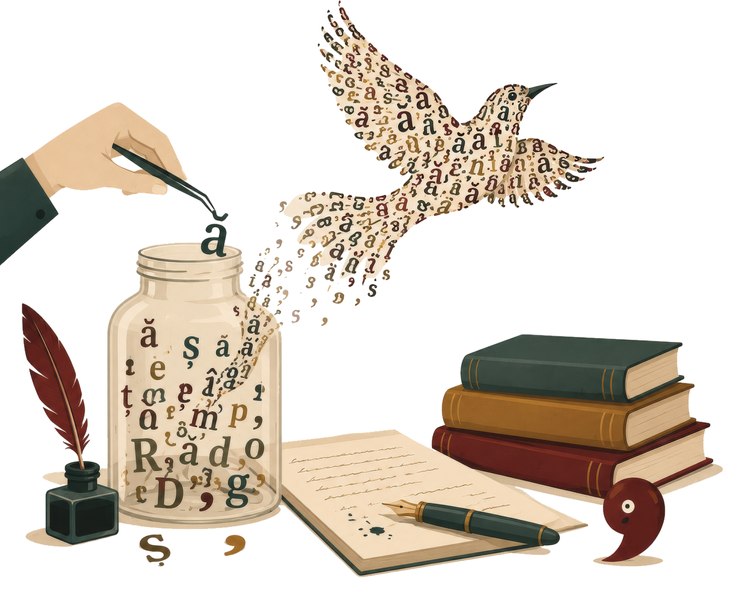
As Romania marks Romanian Language Day on August 31st, a discussion unfolds about the dynamic evolution of the Romanian language. Historically built on a Latin foundation, the language has continuously absorbed influences, akin to a house where each generation adds a room. A century ago, a French accent permeated the speech of the aristocracy, who adopted salon vocabulary from Paris. Post-1989, English entered prominently through television, computers, and the allure of the American dream. Today, a new dialect is being written with thumbs on phones: the language of the internet and social media, characterized by abbreviations, Anglicisms, and emojis that fill gaps where words might be missing.
Yes, a change is clearly happening, but I think it is a transformation. Languages always tend towards simplification, so I do not share the opinion that the degradation of the Romanian language is inevitable.
This transformation prompts a crucial question: Is this a degradation of the language, or a natural evolution, much like the many shifts Romanian has undergone before? Between the chronicles of Miron Costin and Grigore Ureche, preserved in high school textbooks, and the "corporate speak" flooding inboxes, Romanian remains, as poet Nichita Stănescu described, a homeland and a reference point. Regionalisms are fading, incorrect words are becoming normalized through repetition, and artificial intelligence is beginning to write alongside us. These shifts are explored in an investigation by "Weekend Adevărul," featuring insights from historian Adrian Cioroianu, writer Doina Ruști, visual artist Dan Perjovschi, writer and president of the Writers' Union of Romania Varujan Vosganian, philologist Emanuela Timotin, and lexicography researcher Bogdan Harhătă.
If I see a danger on the horizon, it could rather come from AI, artificial intelligence: none of us knows how AI will influence our languages.
Adrian Cioroianu believes these changes are a clear transformation rather than an inevitable degradation, noting that languages naturally tend toward simplification. He identifies artificial intelligence as a potential future influence whose impact on languages remains unknown. Writer Doina Ruști emphasizes the living nature of language, its extraordinary capacity to adapt and reinvent itself. She views borrowings from other languages, even those perceived as "barbarisms," as catalysts for creativity within Romanian's strong structure, capable of integrating foreign elements. Historical precedents suggest that many borrowed words have enriched the language over time.
Language is alive and has an extraordinary capacity to adapt and reinvent itself. Even when we mention barbarisms or the invasion of words from other languages, it is about evolution.
The discussion highlights how Romanian has been shaped by various languages and dialects due to socio-political factors, needs, or trends. From the French influence of over a century ago to the post-communist influx of English, the current impact of the internet and social media dialect is significant. The core question remains whether this represents a decline or a natural adaptation. The consensus among the featured experts leans towards a natural evolutionary process, though the long-term effects of AI introduce an element of uncertainty.
Any borrowing stimulates the creativity of this language with a strong armature and predisposition for modeling foreign bodies.
About this summary
Originally published by Adevărul in Romanian. Translated, summarized, and contextualized automatically by DistantNews, with a note on how the source frames the story. Not individually reviewed before publishing. How this works.
More Stories


From Our Blog

What Gets Lost (and Found) When News Is Translated

The Critical Role of Diaspora Media in Global News

What Travellers Should Know About Countries with Restricted Press

A Digital Nomad's Guide to Following Local News

How the Same Story Looks Different in Different Countries
