


How will Earth be in 5 billion years? The James Webb reveals the future of the Solar System
Translated from Greek, summarized and contextualized by DistantNews.
At a glance
News
Official statement
Context piece
- Earth is expected to be destroyed in about five billion years when the Sun exhausts its fuel, according to a new study.
- Scientists used the James Webb Space Telescope to observe exoplanet WD 1856 b orbiting a "dead" star, providing insights into planetary futures.
- The study suggests that during the Sun's red giant phase, Mercury, Venus, and likely Earth will be destroyed, while the fate of outer planets remains uncertain.
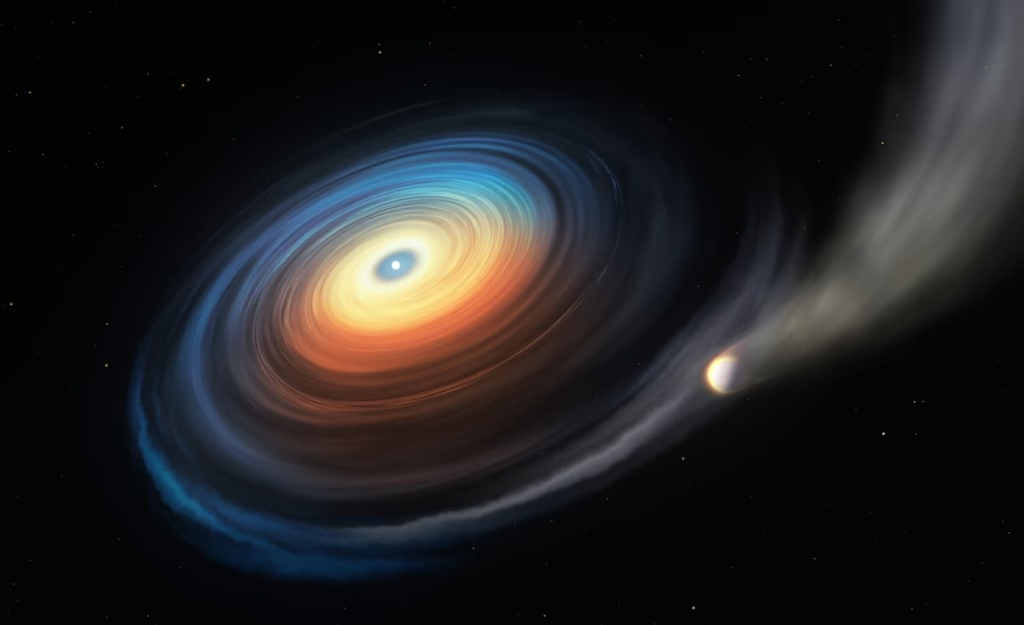
Earth faces destruction in approximately five billion years as the Sun depletes its fuel, according to a new scientific study published in the journal Nature. Researchers from the University of St. Andrews in Scotland utilized the James Webb Space Telescope to study exoplanet WD 1856 b, which orbits a "dead" star.
This research acts as a "time machine," offering a glimpse into the future of our own Solar System. By observing WD 1856 b, scientists were able to calculate its mass, temperature, and atmospheric composition. The exoplanet was found to be significantly hotter than anticipated, leading researchers to conclude it has gradually moved into a close orbit around its white dwarf star.
The study outlines that the Sun will expand into a red giant, increasing its diameter over a hundredfold before eventually collapsing into a white dwarf. During this red giant phase, Mercury, Venus, and potentially Earth are predicted to be destroyed. The long-term fate of the outer planets remains uncertain.
WD 1856 b, discovered in 2020, orbits its white dwarf star at a distance 50 times smaller than Earth's distance from the Sun. It is the first known planet to survive so close to a white dwarf, a phenomenon the new data from James Webb helps explain. The observations, using a "tangential transit" technique, allowed for precise measurements of the planet's mass and temperature, estimated to be four to eleven times that of Jupiter. Its atmosphere's chemical composition was also revealed as starlight passed through it, with infrared radiation indicating a surface temperature of around 126 degrees Celsius.
The planet is truly unusual. It is about the size of Jupiter, but the white dwarf it orbits is about the size of Earth. This means the planet is seven times larger than its star.
DistantNews Editorial
Originally published by Ta Nea in Greek. Translated, summarized, and contextualized by our editorial team with added local perspective. Read our editorial standards.
More Stories



From Our Blog

What Gets Lost (and Found) When News Is Translated

The Critical Role of Diaspora Media in Global News

What Travellers Should Know About Countries with Restricted Press

A Digital Nomad's Guide to Following Local News

How the Same Story Looks Different in Different Countries
