

Humanoid robot sprints to victory in Beijing, beating human world record
Translated from English, summarized and contextualized by DistantNews.
TLDR
- A humanoid robot won a half-marathon in Beijing, completing the 21km race in 50 minutes and 26 seconds.
- The robot's time surpassed the human world record, showcasing China's rapid technological advancements in robotics.
- The event featured over 100 teams, with about 40% of robots navigating autonomously, highlighting progress from the previous year's race.
The second Beijing E-Town Half Marathon and Humanoid Robot Half Marathon on April 19, 2026, has demonstrated China's significant strides in robotics and artificial intelligence. The winning humanoid robot, developed by Honor, not only dominated the competition but also outpaced the human world record, clocking in at an astonishing 50 minutes and 26 seconds for the 21km course. This remarkable achievement underscores China's commitment to technological innovation, as outlined in its latest five-year plan, which prioritizes advancements in science and technology, including humanoid robots.
The winner from Honor, a Chinese smartphone maker, completed the 21km race in 50 minutes and 26 seconds
This event is more than just a race; it's a testament to China's ambition to lead in the global AI race, particularly in competition with the United States. The rapid improvement from last year's inaugural race, where the winning robot finished in over two and a half hours, to this year's record-breaking performance, signifies a leap forward. The participation of over 100 teams, including international competitors, and the autonomous navigation capabilities of many robots, further emphasize the scale and sophistication of the development in this sector.
That was faster than the human world record holder, Uganda’s Jacob Kiplimo, who finished the same distance in about 57 minutes in March.
From a Chinese perspective, this success is a source of national pride and a clear signal of our technological prowess. While Western media might focus on the novelty or potential risks of advanced AI, we see it as a crucial step towards national security and economic competitiveness. The inclusion of robots as traffic officers, directing participants with gestures and voice, offers a glimpse into the practical applications being developed. The ranking of Chinese companies like AGIBOT, Unitree Robotics, and UBTech Robotics as top-tier global vendors further solidifies our leadership in this field.
The performance by the robot marked a significant step forward from last year's inaugural race, during which the winning robot finished in 2 hours, 40 minutes and 42 seconds.
This race highlights a distinct national approach to technological development. While some in the West may express caution, China views these advancements as essential for future growth and security. The focus on developing humanoid robots and their applications is a strategic imperative, directly linked to the nation's goals for economic and technological dominance. The Beijing E-Town race serves as a powerful showcase of this national drive and a harbinger of future innovations.
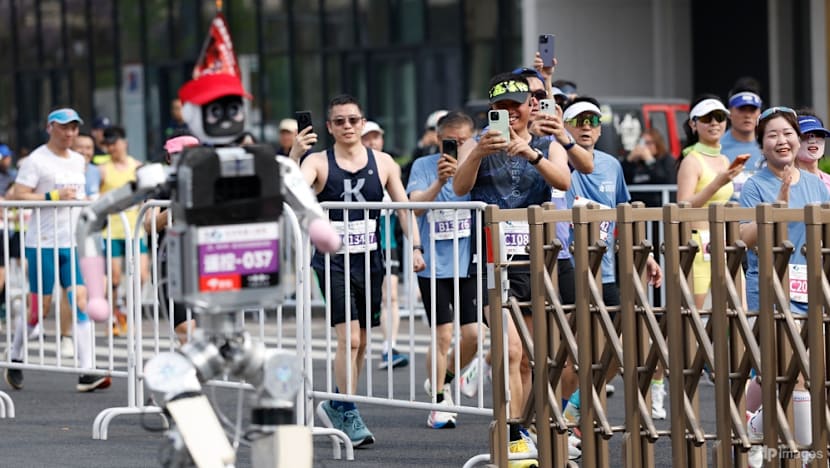
about 40 per cent of the robots navigated the course autonomously, while the others were remotely controlled.
DistantNews Editorial
Originally published by CNA in English. Translated, summarized, and contextualized by our editorial team with added local perspective. Read our editorial standards.
More Stories



From Our Blog

What Gets Lost (and Found) When News Is Translated

The Critical Role of Diaspora Media in Global News

What Travellers Should Know About Countries with Restricted Press

A Digital Nomad's Guide to Following Local News

How the Same Story Looks Different in Different Countries
