


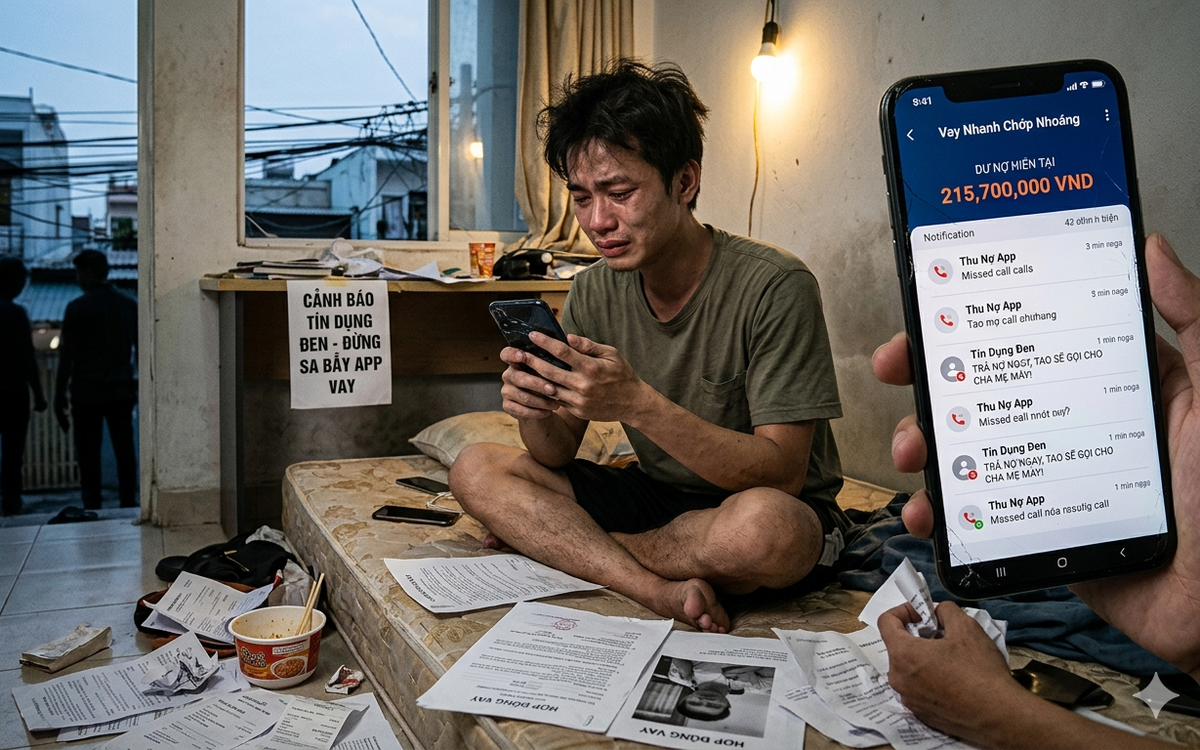
Hundreds of Millions in Debt, How to Break Free from the 'Black App' Cycle?
Translated from Vietnamese, summarized and contextualized by DistantNews.
At a glance
Interview
Named sources
Context piece
- Many young people fall into debt traps by borrowing from "black apps" (unlicensed online lenders), accumulating hundreds of millions of dong despite low incomes.
- Financial planner Doan Ngoc Hung identifies three main causes: the gap between income and lifestyle expectations, a lack of personal financial management skills, and the excessive convenience of these lending apps.
- Hung advises young people to assess their debt levels using a four-threshold system based on the ratio of monthly debt payments to remaining income after essential expenses.
A growing number of young Vietnamese are falling into severe debt cycles, borrowing hundreds of millions of dong from "black apps", unlicensed online lending platforms, even with modest incomes. Financial planner Doan Ngoc Hung explains this phenomenon stems from a combination of factors.
The problem is a combination of three factors.
Hung points to a significant gap between young people's income and their lifestyle expectations, fueled by social media's emphasis on consumption, travel, and maintaining a certain image. When income falls short, borrowing becomes an immediate solution. Compounding this is a widespread lack of personal financial management knowledge; many can earn money but struggle to manage cash flow, build emergency funds, or assess loan risks. This leaves them financially vulnerable to unexpected events like job loss or sudden expenses.
The third critical factor, according to Hung, is the sheer ease of access to these "black apps." Simple procedures allow for quick cash disbursement, often without borrowers fully understanding the interest rates, penalties, and terms. Hung, who has 15 years of experience in financial planning, emphasizes the need for better financial literacy.
Many people know how to earn money but haven't learned how to manage cash flow, build an emergency fund, or assess loan risks.
To help individuals assess their situation, Hung proposes a four-threshold system. The first threshold is considered safe, where monthly debt payments constitute less than 50% of disposable income, leaving room for savings and emergencies. The second threshold is a warning sign, where debt payments exceed 50% of disposable income, indicating a need for adjustment. The third threshold signifies an unsafe situation, where income barely covers essential living costs and debt repayment, leaving no capacity for savings or emergencies. The fourth, and most dangerous, threshold is when income is insufficient even for basic needs and debt obligations, forcing individuals to borrow from new sources to repay old debts. Early recognition of one's threshold is key to regaining control and escaping the debt spiral.
The monthly debt repayment ratio should be less than 50% of the remaining income after deducting essential living expenses each month.
DistantNews Editorial
Originally published by Tuổi Trẻ in Vietnamese. Translated, summarized, and contextualized by our editorial team with added local perspective. Read our editorial standards.
More Stories

From Our Blog

What Gets Lost (and Found) When News Is Translated

The Critical Role of Diaspora Media in Global News

What Travellers Should Know About Countries with Restricted Press

A Digital Nomad's Guide to Following Local News

How the Same Story Looks Different in Different Countries
