


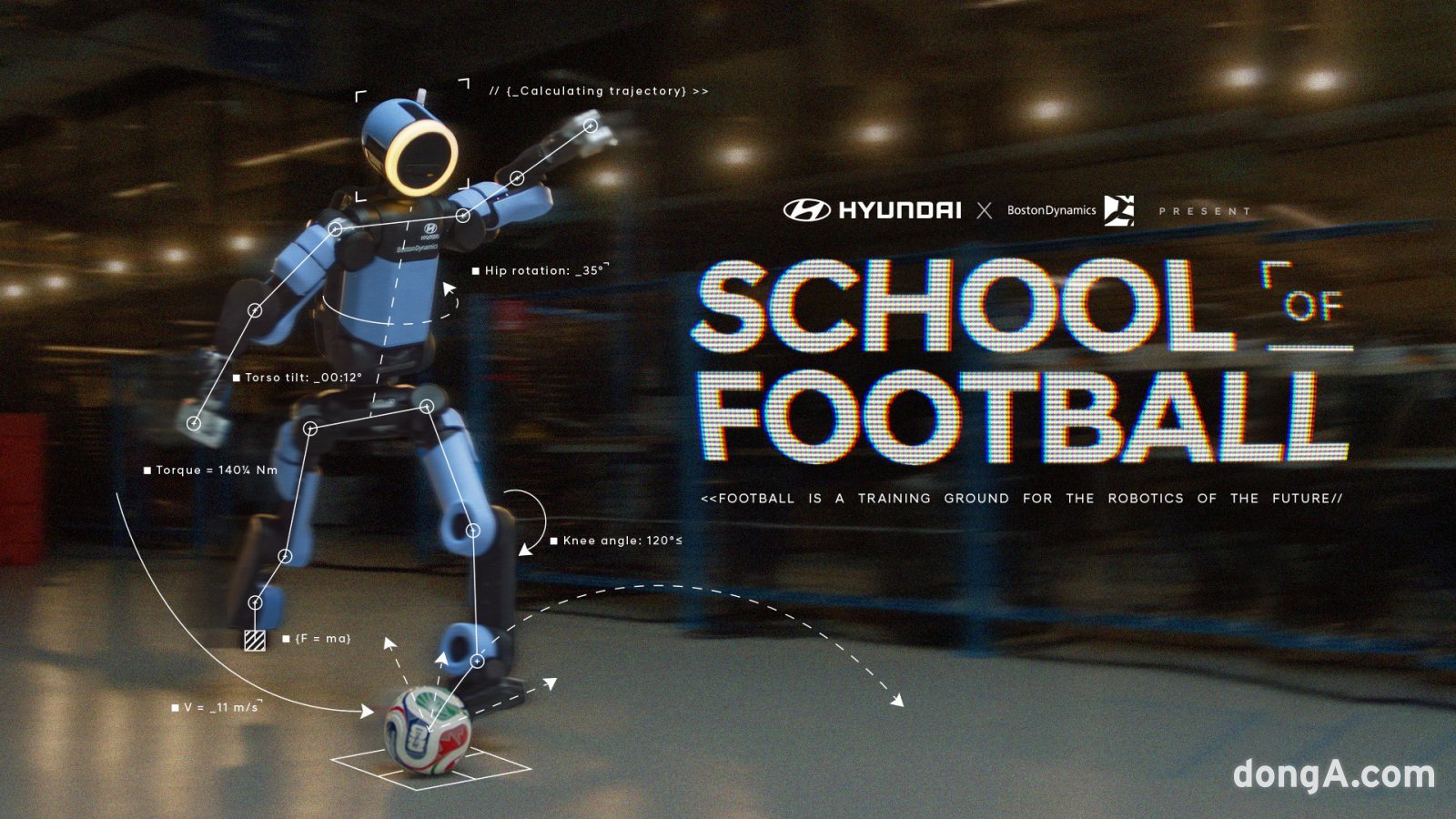
Hyundai unveils advanced humanoid robot Atlas with impressive soccer skills
Translated from Korean, summarized and contextualized by DistantNews.
At a glance
News
Named sources
Context piece
- Hyundai Motor Group has revealed advanced humanoid robot technology, showcasing the Atlas robot performing complex soccer moves, including a "rabona kick."
- The project, part of Hyundai's World Cup campaign, demonstrates robots learning and adapting to human athletic movements, signifying progress in future automation.
- The technology, developed with Boston Dynamics, uses motion capture and AI to enable robots to master intricate physical tasks, with potential applications in logistics and manufacturing.
Hyundai Motor Group is pushing the boundaries of robotics, unveiling sophisticated humanoid robot technology that showcases advanced athletic capabilities. The company released a video detailing the development process of its Atlas robot as it learns and masters complex human movements, including a challenging "rabona kick" in soccer.
This project is a key component of Hyundai's World Cup-related technology campaign, aiming to prove that future automation technologies are rapidly becoming a reality. By demonstrating robots learning intricate sports actions, Hyundai illustrates the expansion of autonomous control in machines. The Atlas robot's ability to precisely execute maneuvers like the rabona kick has captured significant attention from both the industry and the public.
Developing fluid, human-like motion in bipedal robots requires a sophisticated integration of balance, dynamic timing, limb coordination, and environmental adaptability. Researchers chose soccer as the training ground because it demands simultaneous full-body control and precise movements, making it an ideal sport for testing and advancing a robot's physical control limits.
The development process involves motion capture technology to translate real athletes' movements into data, followed by a retargeting process to adapt this information to the robot's specific mechanical constraints. This is followed by AI-driven reinforcement learning, where the robot learns to optimize its balance and force application by calculating its own weight and motor characteristics. The use of cloud-based computing allowed for thousands of parallel simulations, accelerating the learning process significantly.
Beyond sports, Hyundai emphasizes that the algorithms developed for these dynamic movements have direct applications in industrial settings. The ability to navigate and precisely manipulate objects in variable environments can be transferred to tasks in logistics and manufacturing, such as transporting heavy loads and avoiding obstacles. The ultimate goal is to deploy these robots in hazardous or repetitive environments to reduce the burden on human workers.
The goal is to develop them into devices that can reduce the burden of human labor in hazardous or repetitive environments.
DistantNews Editorial
Originally published by Dong-A Ilbo in Korean. Translated, summarized, and contextualized by our editorial team with added local perspective. Read our editorial standards.
More Stories


From Our Blog

What Gets Lost (and Found) When News Is Translated

The Critical Role of Diaspora Media in Global News

What Travellers Should Know About Countries with Restricted Press

A Digital Nomad's Guide to Following Local News

How the Same Story Looks Different in Different Countries
