


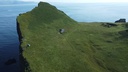
Iceland's 'loneliest house' debunked: No billionaire bunker, no Björk gift
Translated from Croatian, summarized and contextualized by DistantNews.
At a glance
In-depth
Sources not specified
Context piece
- A small white house on the island of Ellidaey, Iceland, has become known as the "loneliest house in the world" due to its remote location.
- Myths surrounding the house include it being a billionaire's survival bunker or a gift to singer Björk, but these are untrue.
- Historically, families lived on Ellidaey, but the harsh conditions led to its abandonment by the mid-20th century; it is now a haven for seabirds.
The stark white house perched on a green slope in the middle of the Atlantic Ocean is one of Iceland's most recognizable images. With no roads, neighbors, or signs of modern life, only steep cliffs, the sea, and the sky surround it. For years, its isolation has earned it the nickname "the loneliest house in the world," and its story has become the subject of many myths.
Many believed it was a billionaire's private retreat preparing for the end of the world, while others claimed it was a gift to Icelandic singer Björk. However, the reality is simpler, and perhaps more intriguing. The house is located on the small island of Ellidaey, part of the Vestmannaeyjar archipelago off Iceland's southern coast. This volcanic area comprises about fifteen islands formed by volcanic activity.
The house is located on the small island of Ellidaey, one of the islands of the Vestmannaeyjar archipelago, along the southern coast of Iceland. It is a volcanic area that makes up about fifteen islands formed by volcanic activity.
Ellidaey is the third-largest island in the archipelago, but its area is just under half a square kilometer. The nearest inhabited place, the town of Heimaey, is about 12 kilometers away by sea. Reaching the island is not easy; there is no proper harbor, the coast is surrounded by steep cliffs, and strong sea currents and unpredictable weather make access difficult. Today, no one lives on the island permanently. Its only permanent residents are numerous colonies of seabirds, most notably the Atlantic puffin.
No one lives on the island permanently today. Its only permanent residents are numerous colonies of seabirds, among which the Atlantic puffin stands out – a bird known for its characteristic orange beak.
One widespread story claimed the Icelandic government gifted the island to Björk as recognition for her contributions to the country. This story has a connection to a real event: in 2000, then-Prime Minister Davíð Oddsson stated he could offer the singer a place on an island for her international promotion of Iceland. However, he was referring to a different island with the same name, Elliðaey, in Breiðafjörður bay in western Iceland, which has no connection to the house in viral photos. The idea was abandoned after public debate, and Björk reportedly withdrew due to concerns about her isolated retreat becoming a tourist attraction.
Another popular theory suggested a wealthy individual built the house to hide from civilization or prepare for disaster. This story also lacks factual basis. People did live on Ellidaey for centuries; several families inhabited the island, engaging in fishing, sheep farming, and hunting seabirds. The island is even mentioned in Icelandic sagas. Life there was extremely difficult, with no shops, doctors, or easy means of leaving. Residents had to provide everything necessary for survival themselves. By the early 20th century, the population began to decline, and by the 1930s, the last inhabitants left.
In 2000, then-Icelandic Prime Minister Davíð Oddsson stated that he could offer the singer the opportunity to settle on an island for her international contribution to the promotion of Iceland.
DistantNews Editorial
Originally published by Večernji List in Croatian. Translated, summarized, and contextualized by our editorial team with added local perspective. Read our editorial standards.
More Stories



From Our Blog

What Gets Lost (and Found) When News Is Translated

The Critical Role of Diaspora Media in Global News

What Travellers Should Know About Countries with Restricted Press

A Digital Nomad's Guide to Following Local News

How the Same Story Looks Different in Different Countries
