


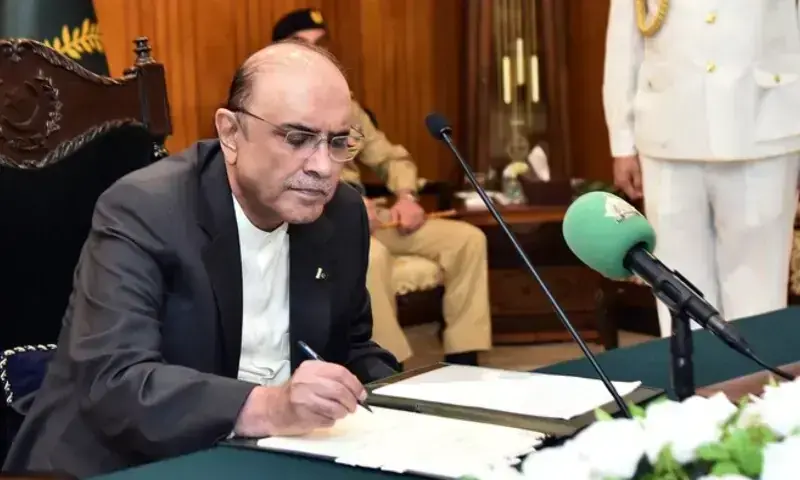
IHC moved over delay in presidential nod for judicial appointments
Summarized and contextualized by DistantNews.
At a glance
News
Named sources
Under investigation
- A petition has been filed in the Islamabad High Court challenging President Asif Ali Zardari's delay in approving judicial appointments recommended by the Prime Minister.
- The petition argues the president's inaction violates constitutional provisions requiring him to act on the advice of the prime minister or cabinet.
- The delay is causing a shortage of judges, hindering the administration of justice and potentially infringing on citizens' right to a fair trial.
A writ petition has been filed in the Islamabad High Court, challenging President Asif Ali Zardari's alleged delay in assenting to a summary forwarded by Prime Minister Shehbaz Sharif for the appointment and confirmation of judges to various high courts. The petition, lodged by advocate Luqman Zafar Chaudhary, urges the court to direct the president to approve the summary for 19 additional judges and the confirmation of five judges across the Islamabad, Lahore, Sindh, Balochistan, and Peshawar high courts.
The only qualification available to the president is contained in the proviso that within fifteen days the president may require the cabinet or, as the case may be, the prime minister to reconsider such advice, whereafter the president shall, within ten days, act in accordance with the advice tendered after such reconsideration.
The Judicial Commission of Pakistan (JCP), led by Chief Justice of Pakistan Yahya Afridi, had recommended these names during meetings on July 20 and 21, following constitutional procedures. The prime minister subsequently forwarded the summary to the president for assent, as required by Article 48 of the Constitution. However, the petition states that the president neither granted assent nor returned the summary, leading to the indefinite postponement of the scheduled oath-taking ceremony for the new judges.
The president was required to act “strictly within the four corners of the Constitution” and cannot allow extraneous considerations to influence or delay the exercise of his constitutional functions.
The petitioner contends that this inaction violates Article 48(1) of the Constitution, which mandates the president to act on the advice of the Cabinet or the prime minister. The petition highlights that the president's only recourse is to request reconsideration within fifteen days, after which he must act according to the reconsidered advice. The filing asserts that the president cannot delay the exercise of constitutional functions without legal justification, citing previous judicial precedents that emphasize acting strictly within constitutional boundaries.
The executive’s role was “narrow, time-bound and essentially formal” and could not be turned into “a power of veto or indefinite deferral”.
The petition further argues that the ongoing shortage of judges is severely impacting the administration of justice, causing case backlogs, and infringing upon the fundamental right to access justice and a fair trial. The legal fraternity and the public, according to the petition, harbor "grave apprehensions" that the delay is driven by extraneous political considerations rather than any bona fide constitutional exercise, potentially undermining the independence of the judiciary.
The continuing shortage of judges was “crippling the administration of justice, delaying the disposal of cases, and directly infringing the fundamental right of access to justice and a fair trial under Articles 9, 10A and 25 of the Constitution”.
DistantNews Editorial
Originally published by Dawn. Summarized and contextualized by our editorial team with added local perspective. Read our editorial standards.
More Stories



From Our Blog

What Gets Lost (and Found) When News Is Translated

The Critical Role of Diaspora Media in Global News

What Travellers Should Know About Countries with Restricted Press

A Digital Nomad's Guide to Following Local News

How the Same Story Looks Different in Different Countries
