


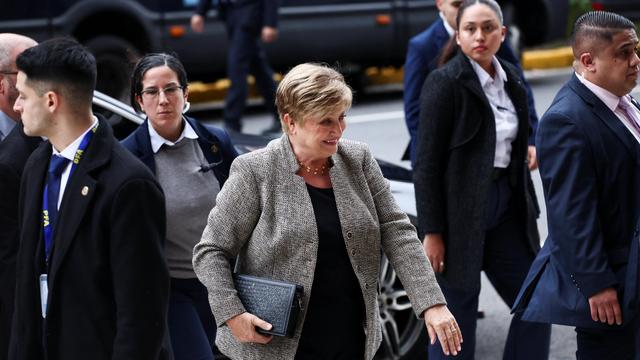
IMF chief praises Milei's austerity measures in Argentina amid economic challenges
Translated from German, summarized and contextualized by DistantNews.
At a glance
News
From a news agency
Context piece
- IMF chief Kristalina Georgieva praised Argentina's economic reforms under President Javier Milei, citing significant progress in macroeconomic and financial stability.
- Georgieva noted reduced inflation, a budget surplus, and improved creditworthiness as results of the government's "hard work" and the "sacrifices of the Argentine people."
- Despite praise, protests continue, and economic indicators show mixed results, with weak private consumption and industrial decline, while the IMF expects economic growth.
Buenos Aires, Argentina – International Monetary Fund (IMF) Managing Director Kristalina Georgieva has lauded the controversial economic reforms implemented by Argentine President Javier Milei, stating that the country has made "considerable progress" toward macroeconomic and financial stability since his inauguration.
During a visit to Buenos Aires, Georgieva described Argentina's situation as "significantly more solid by all metrics." She attributed this development to the "hard work of the government" and the "sacrifices of the Argentine people." Key indicators highlighted include falling inflation, a budget surplus achieved for the first time in 14 years, and improved creditworthiness, benefiting sectors like oil, gas, mining, and agriculture. However, Georgieva also stressed the need for Argentina to create more regular jobs and strengthen consumption.
Milei's administration, which took office in December 2023, has pursued radical cuts in state spending and subsidies. While these austerity measures have yielded a budget surplus and significantly lowered inflation, they have also triggered repeated protests and faced legal challenges. Demonstrations against the government's economic policies were visible even during Georgieva's visit, with people protesting outside the Ministry of Economy.
The economic landscape in Argentina remains complex, marked by contradictory trends. Although annual inflation has decreased to 33.5 percent, economic growth was only 0.2 percent, contrasting with the IMF's projection of 3.5 percent for the year. Private consumption remains weak, and the proportion of households receiving aid for the needy has reached a 20-year high. Economist Patrick Kaczmarczyk criticized Milei's policies, arguing they have destroyed the country's industrial base, which shrank by 7.9 percent between 2023 and 2025 according to UN data. Argentina is the IMF's largest debtor, having agreed to a $20 billion loan program last year.
DistantNews Editorial
Originally published by Die Zeit in German. Translated, summarized, and contextualized by our editorial team with added local perspective. Read our editorial standards.
More Stories


From Our Blog

What Gets Lost (and Found) When News Is Translated

How the Same Story Looks Different in Different Countries

The Critical Role of Diaspora Media in Global News

What Travellers Should Know About Countries with Restricted Press

A Digital Nomad's Guide to Following Local News
