


In Nepal’s flood zone, pilots are flying by their “own discipline”
Summarized by DistantNews. Read the original for the full story.
At a glance
News
Named sources
Ongoing story
- Floods in Nepal’s Rasuwa and Nuwakot districts have erased roads, riverbanks and landmarks, while terrain disrupts contact with ground-based air traffic control.
- Helicopter pilots are coordinating through a shared radio frequency, exchanging positions and traffic information while maintaining separation themselves.
- Trishuli has become the main staging point for rescue flights operated by the Nepali Army, private helicopter companies and emergency teams.
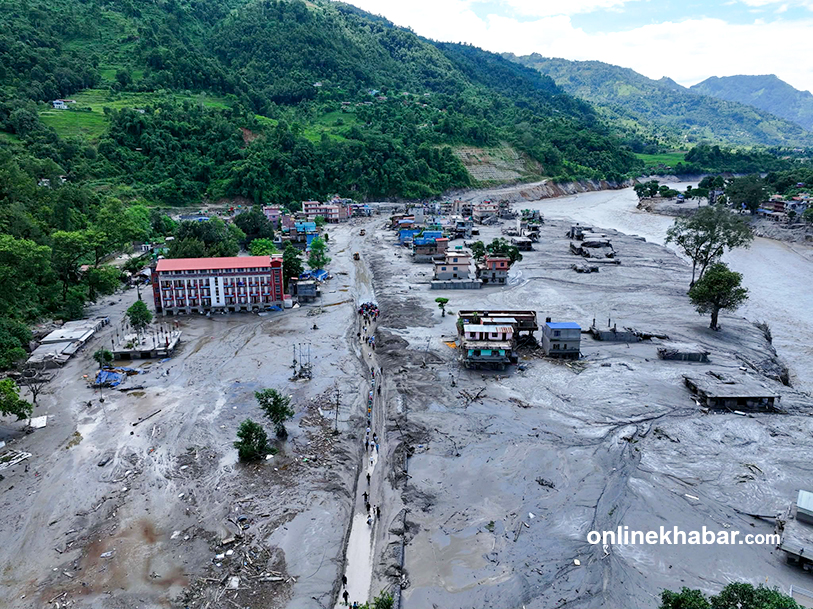
The Bhotekoshi floods have taken away the landmarks helicopter pilots once used to navigate Nepal’s valleys. Roads and riverbanks have disappeared, steep terrain blocks radio signals, and aircraft entering the worst-hit areas move beyond the direct reach of air traffic controllers.
Rescue flights have continued through a system pilots have built among themselves. After helicopters leave Kathmandu, they generally remain in contact with air traffic control for about 15 nautical miles. Beyond that distance, especially at low altitude in narrow valleys, the signal becomes unreliable.
Helicopters are flying while staying in contact with each other on the 120.8 frequency.
Pilots then switch to the common 120.8 frequency. They report their positions, directions and nearby traffic, and keep aircraft apart without instructions from the tower. “Helicopters are flying while staying in contact with each other on the 120.8 frequency,” said Debendra Prasad Shrestha, chief air traffic controller at Tribhuvan International Airport. He said the exchanges cannot be heard in Kathmandu or at nearby airports.
When flying through a valley between two mountains, helicopters travelling in either direction keep to their respective left side.
Bibek Khadka, a senior helicopter instructor and captain with Altitude Air, compared the arrangement with driving on a narrow mountain road. Aircraft travelling in opposite directions keep to their respective left sides, while pilots share information about approaching helicopters. Senior captain Maniraj Lama of Kailash Air said military and private helicopters follow the same practice, including when climbing into valleys and returning.
Trishuli has emerged as the rescue hub for Rasuwa and Nuwakot. Nepali Army helicopters operate from Kathmandu, while private pilots also take part. Rescued people are generally brought first to Trishuli, where the Army, Armed Police Force and medical personnel receive them.
It is like keeping to your lane on a road.
About this summary
Originally published by Kathmandu Post. Summarized and contextualized automatically by DistantNews, with a note on how the source frames the story. Not individually reviewed before publishing. How this works.
More Stories

From Our Blog

News in Translation: What Gets Lost, and How We Keep the Framing

Diaspora Media: How Communities Abroad Follow Home

Traveling Where the Press Is Not Free: How to Read the News There

The Digital Nomad's Guide to Local News

The Same Story, Different Countries: How Coverage Changes at the Border
