


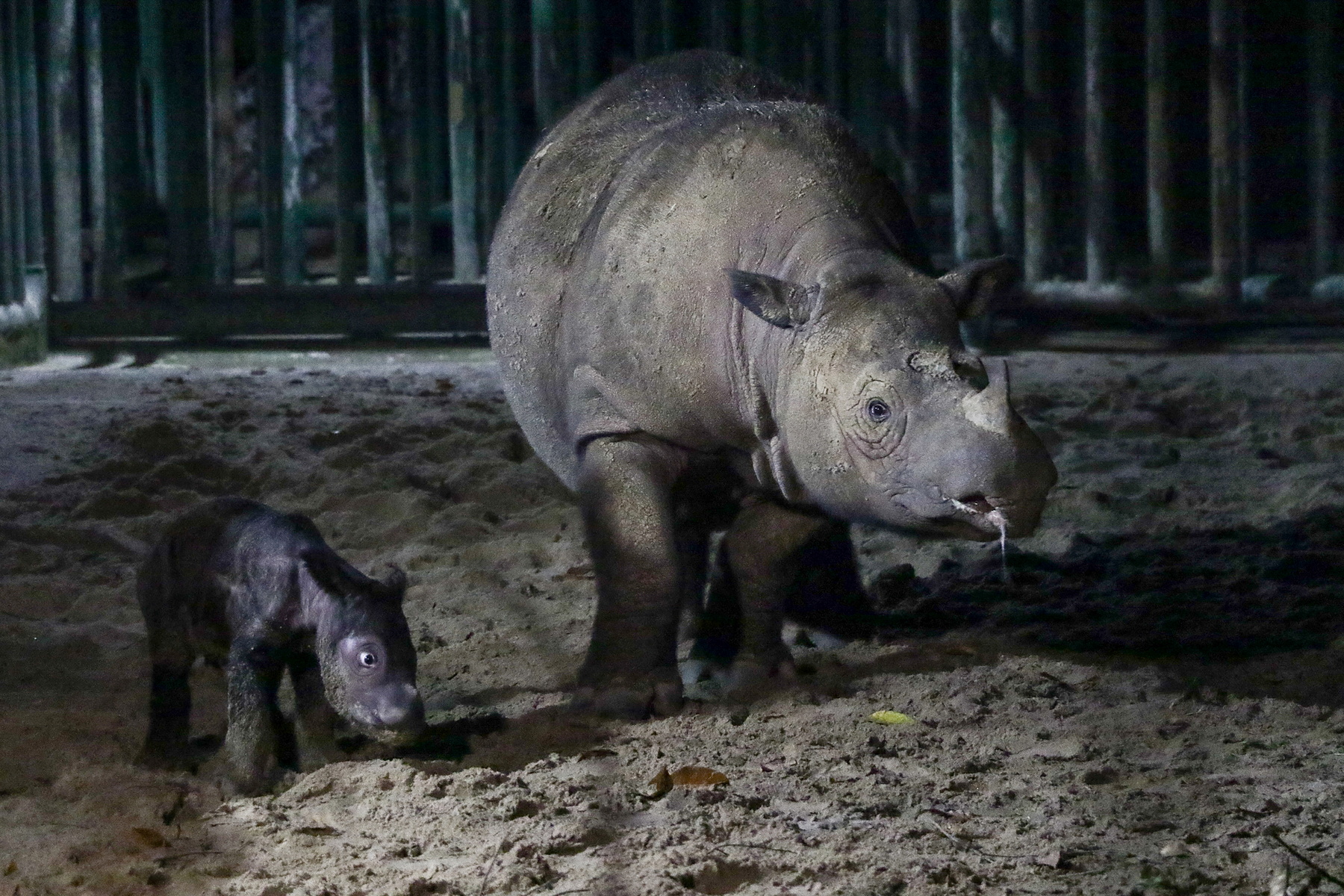
Indonesia plans to capture last wild Borneo rhino for artificial insemination
Translated from German, summarized and contextualized by DistantNews.
At a glance
News
Sources not specified
Ongoing story
- Indonesian conservationists plan to capture the last known wild Borneo rhino, a female named Pari, to attempt artificial insemination.
- The goal is to fertilize Pari's eggs with sperm from a critically endangered Sumatran rhino, aiming to preserve the Borneo rhino's genetic lineage.
- Efforts to collect eggs from another female, Pahu, have failed due to her age and health issues, making Pari the last hope for the species.
Indonesian conservationists are embarking on a critical mission to save the Borneo rhinoceros from extinction. Their plan involves capturing the last known wild female of the species, named Pari, who resides in the Indonesian part of Borneo.
The female Pari, living in the Indonesian part of Borneo, will have eggs removed, which will then be fertilized with sperm from a critically endangered Sumatran rhino.
The ambitious initiative aims to collect eggs from Pari and fertilize them with sperm from a critically endangered Sumatran rhino. Experts hope that the two species are closely related enough for a successful crossbreeding, which could preserve at least some of the Borneo rhino's unique genetic traits. The Borneo rhino is a subspecies of the Sumatran rhino, whose own population has dwindled to just a few dozen individuals across Southeast Asia.
This effort comes after previous attempts to collect eggs from another female Borneo rhino, Pahu, proved unsuccessful. Pahu, estimated to be around 40 years old, suffers from various health problems, rendering her unsuitable for the procedure. Pari, appearing younger in camera trap footage, now represents the final hope for the species' survival.
Pahu is already about 40 years old and also has various health problems.
Capturing a rhino is a complex and delicate operation. Conservationists have spent months preparing, practicing procedures to minimize stress on the animal. They have constructed pitfalls, tested with cattle, and rehearsed all steps to ensure Pari's safety. Following capture, Pari will be housed in a facility for observation before egg retrieval. If artificial insemination is successful in the lab, a surrogate mother rhino may carry the calf to term. This technique follows recent successes in artificial insemination for Southern White Rhinos by German scientists.
so that the animal does not get stressed
DistantNews Editorial
Originally published by Die Presse in German. Translated, summarized, and contextualized by our editorial team with added local perspective. Read our editorial standards.
More Stories



From Our Blog

What Gets Lost (and Found) When News Is Translated

The Critical Role of Diaspora Media in Global News

What Travellers Should Know About Countries with Restricted Press

A Digital Nomad's Guide to Following Local News

How the Same Story Looks Different in Different Countries
