

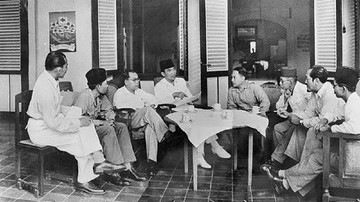
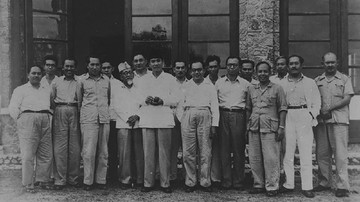
Indonesia's Independence: From Battlefield to Negotiation Table
Translated from Indonesian, summarized and contextualized by DistantNews.
At a glance
News
Sources not specified
Context piece
- Indonesia's struggle for full independence extended beyond the 1945 proclamation, as the Netherlands sought to re-establish colonial control.
- Diplomatic efforts, championed by Prime Minister Sutan Sjahrir, became crucial alongside armed conflict, leading to negotiations like the failed Roem-Royen Agreement and the eventual Conference of Round Table.
- The fight for Indonesian sovereignty involved international diplomacy, including raising the issue of decolonization at the newly formed United Nations Security Council.
Indonesia's path to full independence was not solely paved by the 1945 proclamation; it involved a protracted struggle against Dutch colonial ambitions and a strategic shift towards diplomacy.
Following the declaration of independence, Dutch forces, operating under the Netherlands Indies Civil Administration (NICA), aimed to regain control over the archipelago. This led to renewed armed conflicts in various regions, including the significant battles of Ambarawa and Surabaya, which raged from November 10 to 29, 1945.
Recognizing that physical struggle alone was insufficient, Indonesian Prime Minister Sutan Sjahrir advocated for a diplomatic approach. In his 1946 pamphlet "Perjuangan Kita" (Our Struggle), Sjahrir argued that Indonesia's fate was intertwined with international dynamics. He believed true independence required a global shift away from imperialism and capitalism, warning that any independence gained solely from the Netherlands might be nominal, akin to that of smaller nations under the sway of larger capitalist powers.
Sjahrir's diplomatic strategy included bringing the issue of Indonesian decolonization to the nascent United Nations Security Council in early 1946. The delegation of Ukraine, representing the Soviet Union's interests, voiced Indonesia's cause during early Security Council meetings in London. As historian David van Reybrouck noted in his book "Revolusi, Indonesia and the Birth of the Modern World," this was a pivotal moment for the UN to address decolonization in the post-World War II era, acknowledging that "the times had changed."
Despite these efforts, initial negotiations, such as the first official talks held in April 1946, proved unsuccessful, highlighting the complex and challenging road ahead for Indonesia's complete sovereignty.
DistantNews Editorial
Originally published by CNN Indonesia in Indonesian. Translated, summarized, and contextualized by our editorial team with added local perspective. Read our editorial standards.
More Stories


From Our Blog

What Gets Lost (and Found) When News Is Translated

The Critical Role of Diaspora Media in Global News

What Travellers Should Know About Countries with Restricted Press

A Digital Nomad's Guide to Following Local News

How the Same Story Looks Different in Different Countries
