

Infant's Free Play More Important Than Thought, Researchers Explain
Translated from Polish, summarized and contextualized by DistantNews.
At a glance
News
Sources not specified
Context piece
- Researchers studied 80 nine-month-old infants during free play to understand how body position and object type interact during object exploration.
- The study found that infants touched objects more frequently when sitting independently, especially small, graspable items.
- Findings suggest that an infant's ability to explore objects depends on the combined possibilities offered by their body position and the object's characteristics.
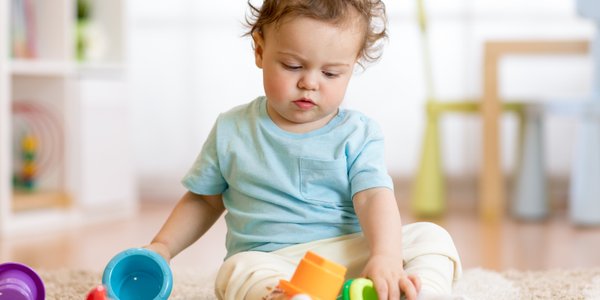
New research suggests that the way infants play and interact with objects is more complex than previously understood, influenced by a dynamic interplay between their body position and the nature of the toys. A study involving 80 nine-month-old infants, conducted by researchers at the Babylab of the Institute of Psychology at the Polish Academy of Sciences (PAN) and Cardiff University, analyzed how babies explore objects in a natural play setting.
The study, published in "Infancy," observed infants as they freely played with various objects, allowing them to change body positions and choose their methods of interaction. Researchers examined the frequency and duration of contact with objects, differentiating between small, easily graspable items and larger, stationary toys that required manipulation.
Key findings revealed that infants were more likely to touch objects while sitting independently. This effect was particularly pronounced with small, graspable items, where sitting independently significantly extended the duration of interaction. In contrast, body position had less impact on interactions with larger, stationary toys.
According to Agata Kozioł, the study's lead author and a doctoral student at Babylab PAN, this highlights that an infant's exploration is not solely determined by their posture or the object itself, but by the combination of both. The research interprets these results through the lens of affordance theory, suggesting that opportunities for action arise from the interaction between the organism and its environment. This means the same object can offer different exploratory possibilities depending on whether the infant is sitting, lying down, or in another position.
The most interesting thing, however, was that independent sitting only prolonged contact with small, graspable objects. For larger, static toys, body position no longer had such a significant impact.
DistantNews Editorial
Originally published by Rzeczpospolita in Polish. Translated, summarized, and contextualized by our editorial team with added local perspective. Read our editorial standards.
More Stories



From Our Blog

What Gets Lost (and Found) When News Is Translated

The Critical Role of Diaspora Media in Global News

What Travellers Should Know About Countries with Restricted Press

A Digital Nomad's Guide to Following Local News

How the Same Story Looks Different in Different Countries
