


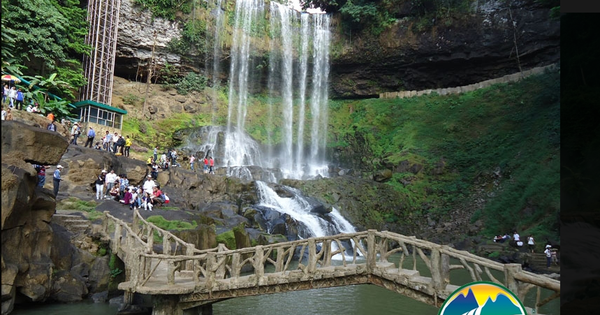
Inspection reveals widespread violations at Damb'ri Waterfall tourist project
Translated from Vietnamese, summarized and contextualized by DistantNews.
At a glance
News
Official statement
Outcome reported
- Lam Dong province's inspection revealed numerous violations in land, construction, and forestry at the Damb'ri Waterfall tourist project.
- The project, managed by Damb'ri Tourism Joint Stock Company, is not eligible for special policy exemptions.
- Violations include issues with land leasing, unpermitted construction, and outdated land-use plans dating back years.
An inspection by Lam Dong province has uncovered a series of long-standing violations concerning land, construction, and forestry at the Damb'ri Waterfall tourist project in Bao Loc city. The provincial inspection authority concluded that the project is ineligible for special policy considerations.
The findings, detailed in inspection conclusion No. 55, highlight widespread irregularities that have persisted for years. The Damb'ri Tourism Joint Stock Company, formerly a state-owned enterprise, has been the project's investor since its conversion to a joint-stock company in 2006. The violations span multiple sectors, including land management, forestry, construction, and the oversight by various provincial departments and local authorities.
Issues began as early as the land leasing phase. The inspection found that the provincial Department of Natural Resources and Environment advised the provincial People's Committee to lease land despite incomplete documentation. Crucially, the land allocation process lacked site boundary marking and field demarcation. Furthermore, land was leased without a land-use application, an investment project proposal, or the required consultations with relevant departments and the investor's land-use needs assessment.
Compounding these issues, the project's land use, construction, and forestry plans have been inconsistent and outdated across multiple periods, leading to management inefficiencies. The project also exceeded its land use duration without the investor initiating renewal procedures. Despite significant delays exceeding 24 months, no action was taken to revoke the project. In the forestry sector, the management of forest land and resources is deemed inadequate, with forest protection and development plans not aligning with land use and construction plans. The allocation of forest land was not synchronized with land allocation, and the investor failed to establish a sustainable forest management plan or monitor forest resource changes as required.
An examination of the site revealed 42 areas and structures. Of the 22 structures built after the company's privatization, 18 lacked construction permits. Only four were legally permitted. These unpermitted structures were also built on land where the use had not been converted, and in many cases, construction occurred without proper land-use conversion.
DistantNews Editorial
Originally published by Thanh Niên in Vietnamese. Translated, summarized, and contextualized by our editorial team with added local perspective. Read our editorial standards.
More Stories



From Our Blog

What Gets Lost (and Found) When News Is Translated

The Critical Role of Diaspora Media in Global News

What Travellers Should Know About Countries with Restricted Press

A Digital Nomad's Guide to Following Local News

How the Same Story Looks Different in Different Countries
