

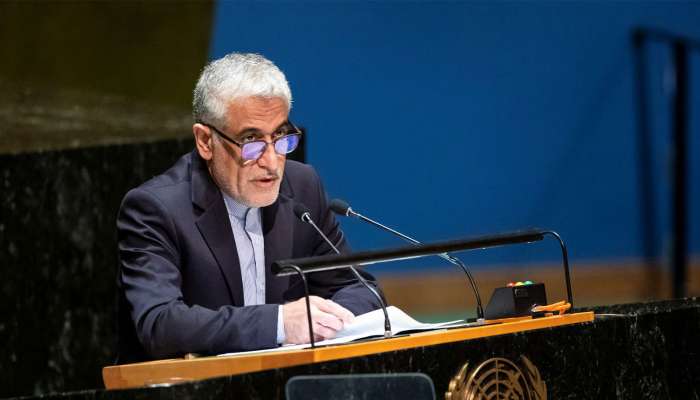
Iran demands end to US blockade as precondition for talks
Translated from English, summarized and contextualized by DistantNews.
TLDR
- Iran has set the lifting of the US naval blockade as a precondition for resuming negotiations.
- Iran's UN Ambassador stated that the US must halt its
Iran has clearly articulated its stance: the United States must cease its naval blockade before any meaningful dialogue can commence. Ambassador Amir Saeid Iravani's remarks to Rudlaw News Network, as reported by Tasnim News Agency, underscore this non-negotiable demand. The blockade, Iran argues, constitutes a violation of the existing ceasefire, and its removal is paramount for any future talks, potentially in Istanbul.
This precondition highlights the profound mistrust that continues to plague relations between Iran and the United States. Despite the US President's announcement of a ceasefire extension, aimed at creating diplomatic space, Iran's insistence on this specific demand suggests a deep-seated skepticism about American intentions. The situation is further complicated by the US President's own claims that Iran is privately seeking the reopening of the Strait of Hormuz to mitigate economic losses, portraying Iran's public posturing as a performance.
The naval blockade of the United States, it is a violation of the ceasefire. And we told them that they should break this blockade. We have received some sign that they are ready to break it. And as soon as they break this blockade, I think that the next round of the negotiation will take place in Istanbul. Listen to them, we have not initiated the military aggression. They initiated the war against us and we are ready. If they want to sit on table and discuss and find a political solution, they will find us ready. If they want to go to the war, in this case also Iran is ready for that
Adding to the prevailing tensions, a recent incident involving an IRGC gunboat firing on a container ship near Oman serves as a stark reminder of the volatile security situation in the Strait of Hormuz. While the damage was contained, the unprovoked attack underscores the risks inherent in this critical waterway. For Iran, the Strait of Hormuz is not just a strategic chokepoint but a vital economic lifeline, and any disruption carries significant implications. The ongoing friction here is a constant threat to global energy markets and maritime security, a reality that resonates deeply within Iran.
Iran doesn't want the Strait of Hormuz closed; they want it open so they can make USD 500 million a day (which is, therefore, what they are losing if it is closed!)
DistantNews Editorial
Originally published by Times of Oman in English. Translated, summarized, and contextualized by our editorial team with added local perspective. Read our editorial standards.
More Stories
From Our Blog

What Gets Lost (and Found) When News Is Translated

The Critical Role of Diaspora Media in Global News

What Travellers Should Know About Countries with Restricted Press

A Digital Nomad's Guide to Following Local News

How the Same Story Looks Different in Different Countries
