



Iran Threatens More Intense Retaliation Against the United States
Translated from Greek and summarized by DistantNews. Read the original for the full story.
At a glance
News
Named sources
Ongoing story
- Iran and the United States have exchanged attacks in recent days, with the Strait of Hormuz at the center of the fighting.
- Iranian officials warned of faster, more intense and more painful retaliation, while the United States threatened to impose greater economic costs.
- The two sides remain at an impasse diplomatically, as restrictions on shipping and attacks on vessels continue.
Iran has warned the United States that its retaliation will become “more intense” after a new series of attacks, mainly at sea and around the strategically important Strait of Hormuz.
The clashes resumed on August 30 after a U.S. initiative, following a reduction in bombing during August. Tehran responded by targeting neighboring states, as it has done since the war began after a U.S.-Israeli attack on February 28. Since Friday, the two sides have focused largely on naval attacks, leaving the strait almost blocked.
more intense
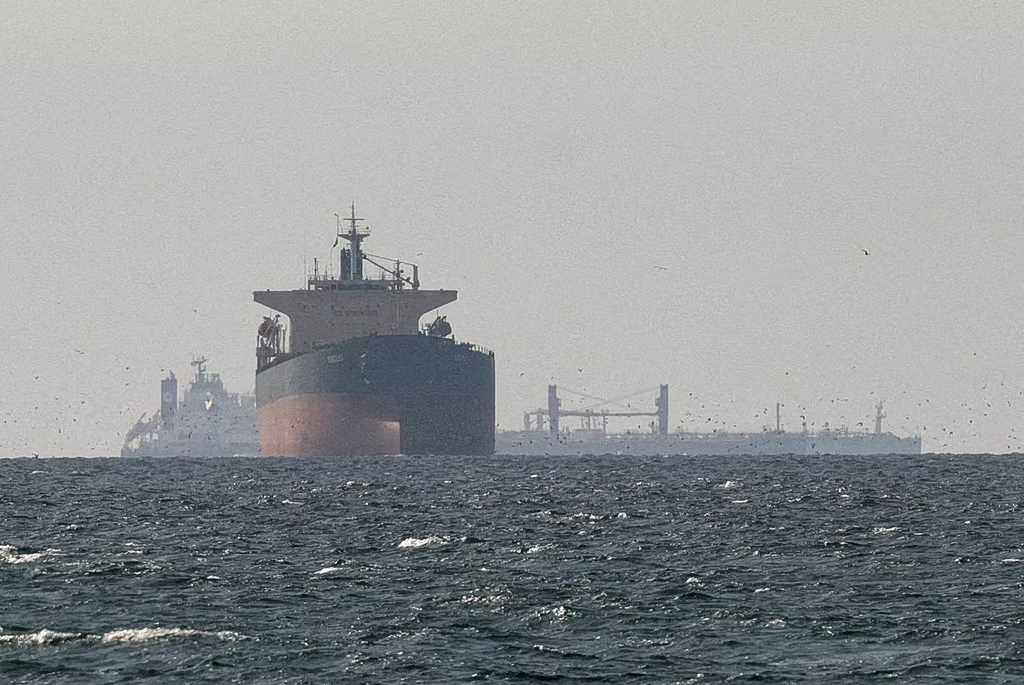
Iran has restricted movement through the waterway, while the United States has blockaded Iranian Gulf ports in retaliation. Mohsen Rezaei, secretary of Iran’s Supreme National Security Council, said a prohibited zone would be declared “in the coming days.” The zone would begin at the U.S. Navy’s blockade line and cover parts of the Gulf. Any vessel entering it would be placed on a sanctions list.
multiple unprovoked Iranian attacks
On Friday, Iranian forces targeted an aircraft carrier and a destroyer. Washington said both escaped “multiple unprovoked Iranian attacks.” The United States retaliated on Saturday by targeting three tankers it linked to Iran’s Revolutionary Guards. The Guards later said they had struck three oil tankers in the Strait of Hormuz and “three other vessels linked to America” elsewhere.
Tehran also said it had attacked a naval drone that tried to “infiltrate” the strait. Tim Hawkins, a CENTCOM spokesman, called that claim a “lie” and said “no American vessel was attacked today.” Iran’s parliamentary speaker and chief negotiator, Mohammad Bagher Ghalibaf, said “the era of proportional retaliation is over,” promising responses that would be faster, more intense and more painful. CENTCOM chief Brad Cooper warned that if Iran fired on two U.S. ships, the United States would impose greater economic costs and strike three.
the era of proportional retaliation is over
The threats continue as negotiations to end the conflict remain deadlocked. U.S. Energy Secretary Chris Wright described Iran’s actions as “an act of desperation,” saying Iranian leaders knew their nuclear program, navy and air force were nearing their end and were clinging to power.
an act of desperation
About this summary
Originally published by Ta Nea in Greek. Translated, summarized, and contextualized automatically by DistantNews, with a note on how the source frames the story. Not individually reviewed before publishing. How this works.
More Stories


From Our Blog

News in Translation: What Gets Lost, and How We Keep the Framing

Diaspora Media: How Communities Follow News From Home

Traveling Where the Press Is Not Free: How to Read the News There

The Digital Nomad's Guide to Local News

The Same Story, Different Countries: How Coverage Changes at the Border
