


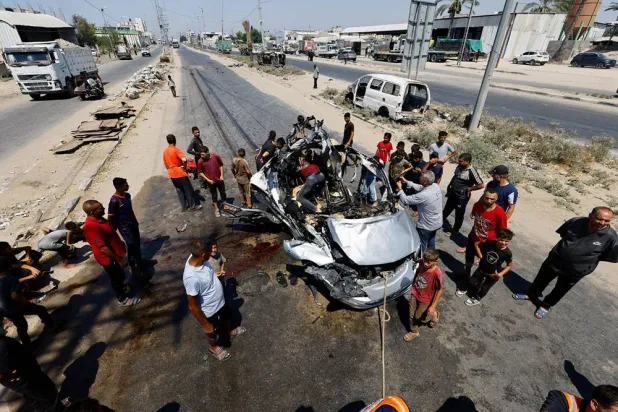
Israeli Strikes Kill 15 in Gaza, Minister Says No Deal to Halt Attacks
Summarized and contextualized by DistantNews.
At a glance
News
Named sources
Ongoing story
- Israeli airstrikes in Gaza killed at least 15 Palestinians on Sunday, marking the highest daily death toll in weeks.
- The strikes hit Gaza City, Deir al-Balah, and Khan Younis, targeting Hamas commanders and operatives.
- Israel's Energy Minister expressed skepticism about Hamas disarming and suggested Israel might need to take full control of Gaza.
Israeli airstrikes pounded Gaza for a second consecutive day Sunday, killing at least 15 Palestinians and marking the highest single-day death toll in weeks, according to medics. The intensified strikes hit Gaza City, the central city of Deir al-Balah, and the southern area of Khan Younis. Palestinian health officials reported that the attacks struck tents, an apartment, and a house, resulting in civilian casualties, including a couple and their young son. The Israeli military stated that strikes targeted Hamas commanders and operatives, including two from the elite "Nukhba" force in Deir al-Balah. Despite these actions, US President Donald Trump had recently announced a breakthrough in efforts to implement a ceasefire agreement. However, Israeli Energy Minister Eli Cohen, a member of Prime Minister Benjamin Netanyahu's security cabinet, voiced strong skepticism. Cohen told Israel's Army Radio that there was no deal to halt attacks on Gaza and suggested Israel might need to seize full control of the enclave if Hamas does not disarm. He emphasized that dismantling Hamas is a prerequisite in any agreement with the United States. Hamas, meanwhile, stated it had shown flexibility and insisted Israel must cease attacks and withdraw troops as per the ceasefire terms before it would consider handing over weapons.
In the deal we signed with the United States, our stance is that Hamas must be dismantled. This is the first thing that must happen.
DistantNews Editorial
Originally published by Asharq Al-Awsat. Summarized and contextualized by our editorial team with added local perspective. Read our editorial standards.
More Stories


From Our Blog

What Gets Lost (and Found) When News Is Translated

The Critical Role of Diaspora Media in Global News

What Travellers Should Know About Countries with Restricted Press

A Digital Nomad's Guide to Following Local News

How the Same Story Looks Different in Different Countries
