


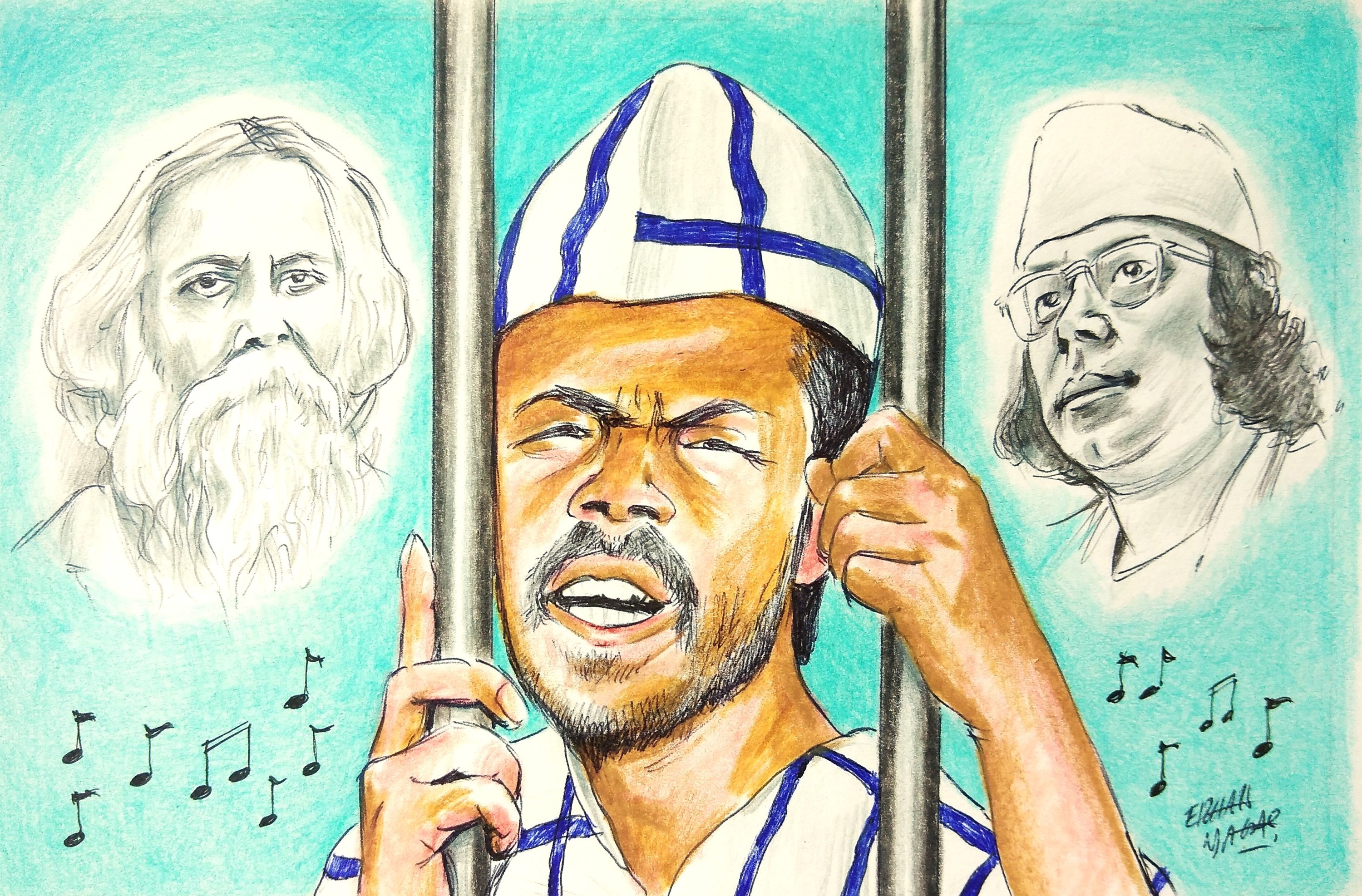
Jailed for singing: Sacred culture of Bengali secularism
Summarized and contextualized by DistantNews.
At a glance
In-depth
Sources not specified
Context piece
- Bangladeshi internet performer Hero Alom faced backlash and police scrutiny for singing songs by revered poets Rabindranath Tagore and Kazi Nazrul Islam.
- Accused of "distorting" cultural heritage, Alom's case highlighted societal anxieties about who can legitimately engage with national cultural symbols.
- The incident reveals how Bengali secular culture, while presenting itself as inclusive, can develop its own forms of symbolic protection and policing around cultural figures like Tagore.
Internet performer Hero Alom found himself at the center of a national controversy in Bangladesh after police summoned him in 2022 over renditions of songs by poets Rabindranath Tagore and Kazi Nazrul Islam. Accused of "distorting" cultural heritage, Alom was reportedly pressured to cease his performances. What began as an amateur online act escalated into a public debate, drawing ridicule and police interrogation, raising questions about why a singer faced state attention for what some perceived as merely singing badly.
The answer, the article suggests, lies beyond musical ability. Hero Alom, born Ashraful Alom, emerged from rural, economically marginalized Bangladesh, outside the traditional cultural elite. He gained fame through low-budget videos and improvised performances, cultivating a public image many urban middle-class audiences found aesthetically crude. Despite mockery for his appearance, accent, and mannerisms, his popularity grew as he represented a figure unbound by elite cultural control.
Rabindranath Tagore, conversely, holds a paramount position in Bengali cultural life. His influence extends beyond present-day national borders, with his song "Amar Sonar Bangla" becoming Bangladesh's national anthem. For many cultural elites, Tagore symbolizes refinement and moral imagination, defining who is considered "properly Bengali." When Alom sang Tagore, the reaction shifted from amusement to moral anger, with cultural commentators deeming his performances insults to Bengali heritage and justifying punitive action.
The core issue was not Alom's vocal imperfection, as countless poor performances circulate online without similar outrage. His transgression was symbolic: entering a culturally protected space without the aesthetic legitimacy historically associated with Rabindra Sangeet. He did not embody the refined "bhadralok" (gentleman) image tied to elite Bengali culture. His background, speech, class, and style were deemed culturally unauthorized. This reveals a sociological tension: while Bengali secular culture often champions liberalism and inclusivity, it has developed its own forms of sanctity and symbolic protection around key cultural figures, with Tagore occupying a particularly sensitive position.
DistantNews Editorial
Originally published by Daily Sabah. Summarized and contextualized by our editorial team with added local perspective. Read our editorial standards.
More Stories


From Our Blog

What Gets Lost (and Found) When News Is Translated

The Critical Role of Diaspora Media in Global News

What Travellers Should Know About Countries with Restricted Press

A Digital Nomad's Guide to Following Local News

How the Same Story Looks Different in Different Countries
