


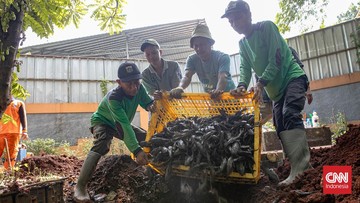
Jakarta Governor to Consult Scholars on Catfish Disposal After MUI Criticism
Translated from Indonesian, summarized and contextualized by DistantNews.
TLDR
- Jakarta Governor Pramono Anung will consult Islamic scholars regarding the method of burying invasive catfish alive, following criticism from the Indonesian Ulema Council (MUI).
- The policy to capture and bury the catfish is due to their overwhelming population in Jakarta's waters, which disrupts the ecosystem.
- MUI raised concerns that burying the fish alive contradicts Islamic principles of mercy and animal welfare, despite acknowledging the environmental benefit.
The Indonesian Ulema Council (MUI) has raised a significant point of contention regarding the Jakarta provincial government's method of controlling the invasive catfish population: burying them alive. Governor Pramono Anung has responded by stating his intention to consult with Islamic scholars to find a method that aligns with Sharia law, acknowledging the MUI's concerns about animal welfare and the Islamic principle of 'rahmatan lil 'alamin' (mercy to all creation).
Regarding the question, there are suggestions and criticisms from MUI, I will ask the experts to adjust the procedures.
CNN Indonesia reports that the Jakarta government's initiative to tackle the 'ikan sapu-sapu' (pleco catfish) stems from their dominance in the city's waters, reportedly exceeding 60-70% of the aquatic biomass. This ecological imbalance threatens native fish species and the overall health of Jakarta's waterways. The government views this control measure as a necessary step for environmental protection, aligning with the principle of 'hifẓ al-bī'ah' (environmental preservation).
However, the MUI, through its Secretary of the Fatwa Commission, KH Miftahul Huda, has highlighted that while the goal of controlling invasive species is justifiable under the principle of 'hifẓ al-nasl' (preserving lineage or species), the method employed is problematic. Burying the fish while alive is seen as causing unnecessary suffering, contradicting the Islamic emphasis on 'ihsan' (benevolence) and animal welfare. This nuanced perspective from MUI underscores a core tenet of Islam: that even in necessary actions like pest control, the method must be humane.
Indeed, these catfish are more than 60 percent of the aquatic life in Jakarta. Even the Ministry of Maritime Affairs and Fisheries reports more than 70 percent, but I say more than 60 percent.
From our perspective at CNN Indonesia, this situation presents a fascinating intersection of environmental policy, religious interpretation, and public administration. Governor Anung's willingness to engage in dialogue with the MUI demonstrates a commitment to finding solutions that are both effective for the environment and ethically sound according to Islamic teachings. This approach reflects a uniquely Indonesian way of navigating complex issues, where religious values are integral to public policy discussions, ensuring that governance serves not only practical needs but also upholds moral and spiritual principles.
The method is considered to cause unnecessary suffering.
DistantNews Editorial
Originally published by CNN Indonesia in Indonesian. Translated, summarized, and contextualized by our editorial team with added local perspective. Read our editorial standards.
More Stories



From Our Blog

What Gets Lost (and Found) When News Is Translated

The Critical Role of Diaspora Media in Global News

What Travellers Should Know About Countries with Restricted Press

A Digital Nomad's Guide to Following Local News

How the Same Story Looks Different in Different Countries
