


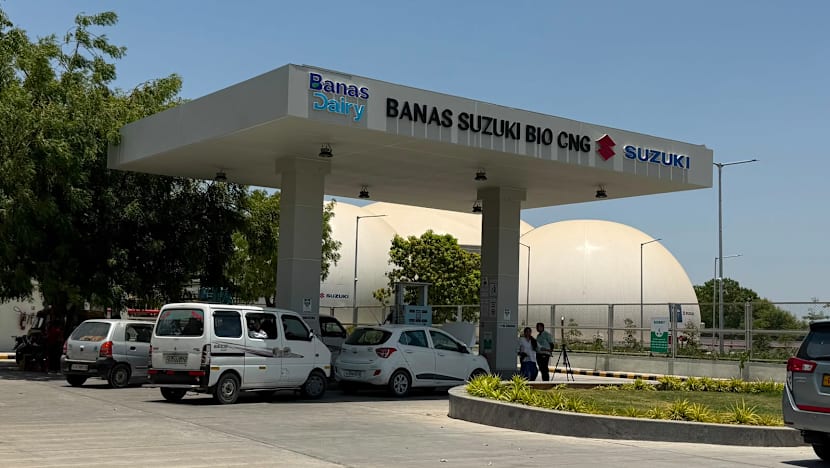
Japan bets on cow dung and farm waste to fuel growth in India's car market
Translated from English, summarized and contextualized by DistantNews.
At a glance
News
Named sources
Context piece
- Japan and India are partnering to produce biogas for vehicles, aiming to establish 1,000 biogas plants by 2030 to power 2.5 million vehicles.
- Maruti Suzuki, India's largest carmaker and a subsidiary of Japanese automaker Suzuki Motor, has approved four biogas projects worth $58.8 million as part of its expansion.
- Analysts note India's agricultural sector and growing CNG vehicle fleet favor biogas adoption, but challenges remain in supply chains and distribution.
Japan is investing in India's automotive market by promoting biogas fuel derived from cow dung and farm waste. The two nations have launched an initiative to build 1,000 biogas plants across India by 2030, with the goal of fueling 2.5 million vehicles.
Maruti Suzuki, India's largest car manufacturer and a subsidiary of Japan's Suzuki Motor, has already approved four biogas projects totaling 5.61 billion rupees ($58.8 million) in the first phase of its expansion. This move aligns with India's potential for biogas adoption, supported by its vast agricultural sector, a growing fleet of compressed natural gas (CNG) vehicles, and a slower pace of electric vehicle (EV) uptake compared to global trends.
Around half of India’s car market is priced below 1.5 million rupees, where customers need value-for-money choices and good mileage. Most hybrid and EV options are available above that price point, which makes CNG an important solution.
Analysts suggest that higher imported oil prices and the significant upfront cost of EVs make CNG vehicles increasingly attractive in India. Retail sales of CNG vehicles saw a nearly 17% year-on-year increase in June, capturing 24.3% of passenger vehicle sales, surpassing EVs at 7.8%. The cost-effectiveness of CNG is a major draw, with CNG cars typically costing less to fuel over distance than their petrol counterparts.
However, challenges persist. Translating these ambitions into reality will require overcoming fragmented supply chains and distribution hurdles in a country of 1.4 billion people. The technology itself is straightforward, converting agricultural waste and cattle dung into purified biogas for compatible CNG vehicles, while also producing organic fertilizer.
Vehicle acquisition costs have risen because of tighter emission and safety norms, while high petrol prices have also increased running costs. CNG offers more.
DistantNews Editorial
Originally published by CNA in English. Translated, summarized, and contextualized by our editorial team with added local perspective. Read our editorial standards.
More Stories



From Our Blog

What Gets Lost (and Found) When News Is Translated

The Critical Role of Diaspora Media in Global News

What Travellers Should Know About Countries with Restricted Press

A Digital Nomad's Guide to Following Local News

How the Same Story Looks Different in Different Countries
