


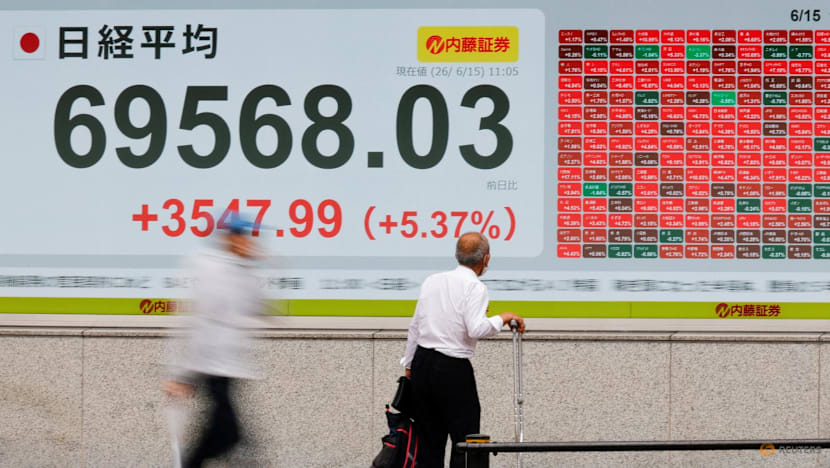
Japanese stocks surge to all-time high as US, Iran reach peace deal framework
Translated from English, summarized and contextualized by DistantNews.
At a glance
News
Named sources
New plan
- Japanese stocks surged to an all-time high, and government bond yields fell after the US and Iran agreed on a preliminary peace deal.
- The agreement includes halting the US blockade of Iran and reopening the Strait of Hormuz, with a formal signing expected Friday.
- The Nikkei 225 index jumped 5.5% to 69,657.09, while the broader Topix climbed 3.8%.
Japanese financial markets experienced a significant rally on Monday, with equities reaching an all-time high and government bond yields tumbling. This surge followed news of a preliminary peace framework agreement between the United States and Iran, aimed at ending their conflict.
The accord, set to be officially signed in Switzerland on Friday, includes provisions for the US to halt its blockade of Iran and for the reopening of the Strait of Hormuz. The announcement led to a drop in oil prices, though the future of Iran's nuclear program remains subject to further negotiations.
The Nikkei 225 index saw a substantial increase, climbing as much as 5.5% to reach 69,657.09, surpassing the 69,000 level for the first time. The broader Topix index also performed strongly, rising 3.8% to 4,028.06.
This is simply the market reacting to the ceasefire deal - nothing more, nothing less. Even a rise of around 4 per cent does not look unnatural. The key issue going forward will be the substance of the agreement itself and whether it is actually implemented and upheld.
Shingo Ide, chief equity strategist at NLI Research Institute, commented on the market's reaction, stating, "This is simply the market reacting to the ceasefire deal - nothing more, nothing less. Even a rise of around 4 per cent does not look unnatural." He added, "The key issue going forward will be the substance of the agreement itself and whether it is actually implemented and upheld."
Japanese government bond yields declined amid easing inflation concerns. The benchmark 10-year JGB yield fell 5.5 basis points to 2.58%, while the 20-year JGB yield slid 7.5 basis points to 3.445%. The two-year yield, sensitive to Bank of Japan policy, lost 2 basis points to 1.39%, and the five-year yield dropped 4 basis points to 1.86%. In currency markets, the Japanese yen saw little change against the US dollar, trading at 160.19.
Despite recent geopolitical turmoil, strategists have maintained a bullish outlook on Japanese stocks, driven by optimism surrounding AI investments and corporate governance reforms. The Nikkei has already seen a year-to-date increase of approximately 31%. However, some caution remains regarding the current high valuation of the Nikkei. Hiroyuki Ueno, chief strategist at Sumitomo Mitsui Trust Asset Management, noted, "The valuation for Japanese equities is still low but there is caution for the Nikkei's current level. Today's gain is probably partly led by demand for short covering. There are some investors who must buy Japanese stocks today. But market players who are long on Japanese stocks would not scoop up stocks at this high."
The valuation for Japanese equities is still low but there is caution for the Nikkei's current level. Today's gain is probably partly led by demand for short covering. There are some investors who must buy Japanese stocks today. But market players who are long on Japanese stocks would not scoop up stocks at this high.
DistantNews Editorial
Originally published by CNA in English. Translated, summarized, and contextualized by our editorial team with added local perspective. Read our editorial standards.
More Stories


From Our Blog

What Gets Lost (and Found) When News Is Translated

The Critical Role of Diaspora Media in Global News

What Travellers Should Know About Countries with Restricted Press

A Digital Nomad's Guide to Following Local News

How the Same Story Looks Different in Different Countries
