


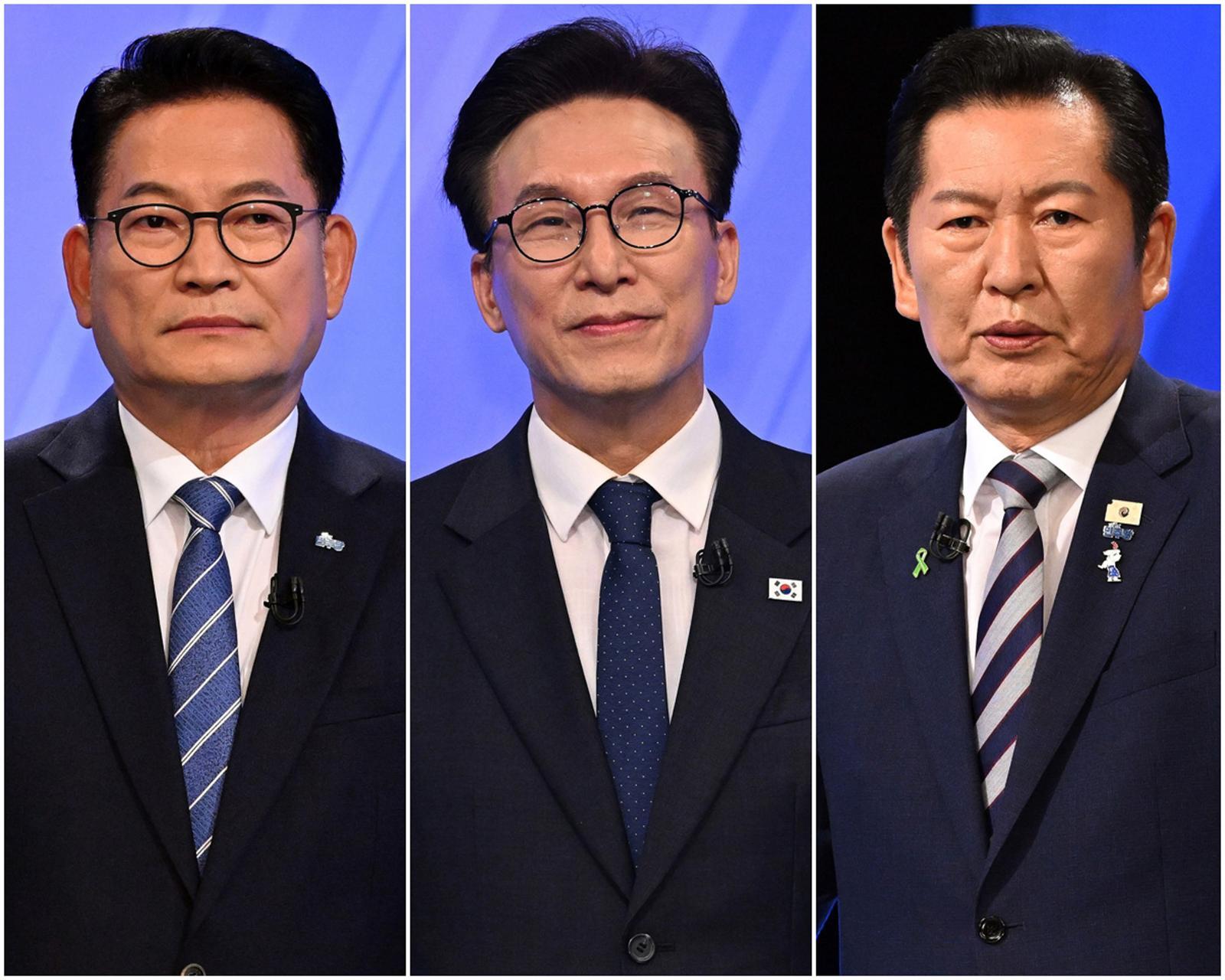
Jung Chung-rae: 'If I become leader, I will investigate Kim Min-seok' - Kim: 'Is warning Shincheonji an act of treason?'
Translated from Korean, summarized and contextualized by DistantNews.
At a glance
News
Sources not specified
Context piece
- Rival candidates for the Democratic Party leadership engaged in heated exchanges during a televised debate, focusing on local election accountability and judicial reform.
- Candidate Jung Chung-rae attacked Kim Min-seok's past defection to support a rival candidate in 2002 and his handling of financial products.
- Candidates also clashed over allegations of interference by the Shincheonji religious group in the party's primary and the pace of judicial reform.
Tensions flared during the second televised debate for the Democratic Party's leadership race, as candidates Jung Chung-rae and Kim Min-seok traded sharp barbs over responsibility for the recent local elections and the ongoing push for judicial reform. The debate, held on August 5, saw the contenders escalate their attacks, with Jung and Kim separated by a mere 0.99% in the cumulative vote from the first round of regional primaries.
You have to eat what you can digest.
Kim Min-seok directly challenged Jung Chung-rae's assertion that the local elections were a "victory" for the Democratic Party. Kim questioned Jung's statement, pointing out that the president himself had described the election results as difficult to define as a victory. "You have to eat what you can digest," Kim stated, implying Jung was misrepresenting the situation. Jung retaliated by bringing up Kim's past defection from the Democratic Party in 2002 to support candidate Chung Mong-joon, asking if Kim remembered the anger of the party's supporters. Jung likened Kim's return to the party after 18 years to someone demanding the house deed after being away, questioning if such actions would bring prosperity.
Do you remember how angry our supporters were when you left the Democratic Party to go to Chung Mong-joon?
The debate also delved into sensitive issues such as judicial reform and alleged interference by the Shincheonji religious group. Kim Min-seok criticized Jung Chung-rae for repeatedly raising the issue of judicial reform, suggesting it was being exploited for the party convention. He also questioned Jung's stance on comments made by author Yoo Si-min, who had criticized the president's commitment to judicial reform. Jung, in turn, accused Kim of hypocrisy regarding judicial reform, questioning why Kim had not acted sooner and asserting that the public knew who had more strongly advocated for it. The exchange grew heated when Kim raised allegations of Shincheonji's interference in the primaries, questioning if warning against such interference was an act of treason. Jung vehemently denied this, calling it a malicious claim that endangered the party's existence and vowed to investigate Kim if he became party leader.
Why didn't you call me in May? And why didn't you submit the Prime Minister's Office TF bill then?
Song Young-gil, another candidate, criticized Jung Chung-rae's communication style, comparing it to the Red Guards attacking party leadership during the Mao Zedong era. Jung accused Song of being overly harsh towards him while being lenient with Kim. The candidates also touched upon Jung's past decision regarding the impeachment of the Supreme Court chief justice, with Jung explaining that such a decision required broader party consensus.
Is warning a religious group about primary interference an act of treason?
DistantNews Editorial
Originally published by Dong-A Ilbo in Korean. Translated, summarized, and contextualized by our editorial team with added local perspective. Read our editorial standards.
More Stories


From Our Blog

What Gets Lost (and Found) When News Is Translated

The Critical Role of Diaspora Media in Global News

What Travellers Should Know About Countries with Restricted Press

A Digital Nomad's Guide to Following Local News

How the Same Story Looks Different in Different Countries
