


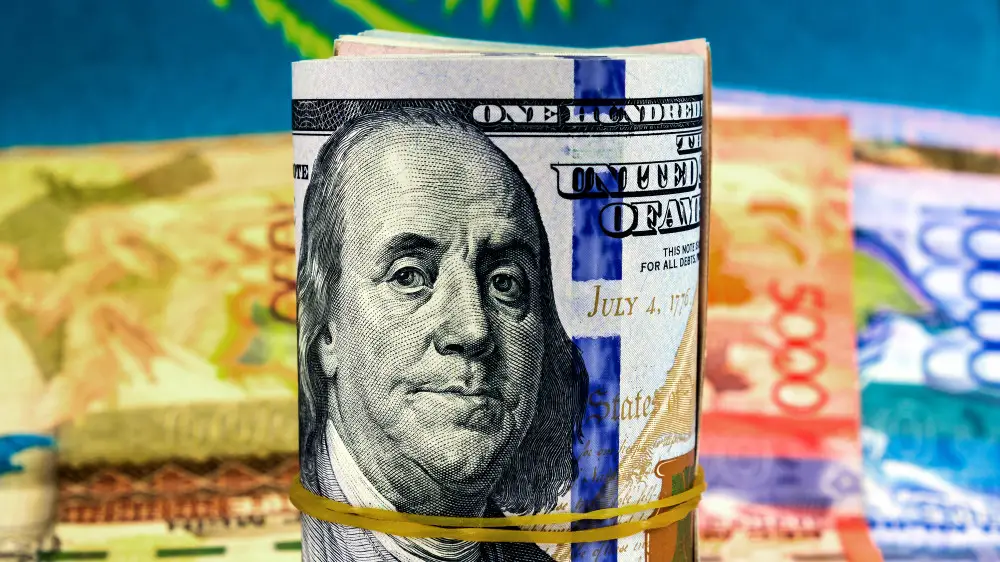
Kazakh Tenge Surges Against Dollar, Experts Cite Investment and National Bank Actions
Translated from English, summarized and contextualized by DistantNews.
At a glance
News
Named sources
Context piece
- The Kazakh tenge strengthened significantly against the US dollar over the past week, appreciating by 2.7 percent and reaching an intraday low of 470.06 tenge.
- Analysts attribute the tenge's rise to non-resident investment in the stock market and foreign currency sales by the National Bank, despite a recent base rate cut and declining global oil prices.
- The National Bank's mechanism to mirror transfers from the National Fund, involving selling foreign currency, is also identified as a key internal factor supporting the tenge's appreciation.
The Kazakh tenge has shown remarkable strength against the US dollar, appreciating by 2.7 percent in a single week and reaching an intraday low of 470.06 tenge. This surge marks a significant reversal from late February when the dollar last exceeded 500 tenge, with the US currency depreciating by 13.9 percent since then.
Analysts point to a confluence of factors driving this trend. A notable contributor is the influx of non-resident investment into Kazakhstan's stock market, a phenomenon confirmed by National Bank Governor Timur Suleimenov. Additionally, substantial foreign currency sales by the National Bank, conducted as part of its gold operation mirroring mechanism, have bolstered the tenge.
A high base rate inherently incentivizes investors because investing in tenge remains profitable. The interest rate differential (compared to other countries) is still favorable. 'Hot money' is still circulating in our market.
This strengthening occurs despite conditions that might typically suggest otherwise. The National Bank recently lowered its base rate from 18 to 17 percent in early June, a move that could theoretically diminish the attractiveness of the Kazakh stock market for foreign investors. Furthermore, global oil prices have been on a downward trajectory since mid-May, with Brent crude declining by nearly 30 percent.
Financial analyst Arman Beisembaev explains that these factors have not hindered the tenge's rise. He notes that the base rate, despite the recent reduction, remains high enough to continue attracting international investors due to favorable interest rate differentials. Beisembaev also highlights the role of the National Bank's new mechanism, implemented in June, to "mirror" transfers from the National Fund. This involves selling additional foreign currency from the fund on the domestic market, with $200 million sold in June and plans for another $460 million by year-end. This consistent supply of foreign currency is identified as a significant internal driver of the tenge's appreciation, independent of external factors like oil prices or global inflation.
The ongoing tranches from the National Fund act as a supply of foreign currency and contribute to the additional strengthening of the tenge, this is an internal factor. It does not depend on oil prices, inflation, or the base rate. These are tranches from the National Fund intended to replenish the budget. They are significant as a standalone factor.
DistantNews Editorial
Originally published by Tengrinews in English. Translated, summarized, and contextualized by our editorial team with added local perspective. Read our editorial standards.
More Stories


From Our Blog

What Gets Lost (and Found) When News Is Translated

The Critical Role of Diaspora Media in Global News

What Travellers Should Know About Countries with Restricted Press

A Digital Nomad's Guide to Following Local News

How the Same Story Looks Different in Different Countries
